





Key Takeaways
- AI SEO means two different things at once: using AI tools to do SEO work faster, and optimizing your content so AI engines like ChatGPT and Google AI Overviews quote it.
- Traditional SEO fundamentals still matter. AI SEO is a layer on top of them, not a replacement for them.
- The fastest wins come from structure machines can read: clean headings, accurate schema, and a clear llms.txt file.
- You cannot improve what you cannot see. Track which AI crawlers visit and which pages get cited, not just Google rankings.
- On WordPress, a free plugin like RankReady handles the discovery and measurement layer so you can focus on the writing.
A client called me last spring, half proud and half confused. Their main service page had finally hit number one on Google for the term they had chased for two years. Same week, they asked ChatGPT which company to hire for that exact service, and it named a competitor they had never even heard of. They were winning the ranking and losing the recommendation. That gap is what people are really asking about when they search for AI SEO.
The phrase gets thrown around as if it means one clear thing. It does not. AI SEO is two separate ideas wearing the same name, and most of the confusion online comes from blending them. This guide pulls them apart, shows how each one works on WordPress, and points you to the deeper guides for every piece.
What Is AI SEO, Really? Two Definitions, One Term
When someone says AI SEO, they mean one of two things, and sometimes both without realizing it.
The first meaning is using AI to do SEO work. That is keyword research, topic clustering, drafting, and schema generation done with help from large language models instead of by hand. The goal here is speed and scale for the same old target: ranking on Google.
The second meaning is optimizing so that AI engines cite you. When a reader asks ChatGPT, Perplexity, or Google AI Overviews a question, those systems read content, pick a few trustworthy sources, and quote them. Getting picked is a different target with different rules. People call this answer engine optimization, generative engine optimization, or LLM SEO, but it is the same idea: be the source the machine quotes.
Both halves are real and both matter. The mistake is treating a tip from one half as if it solves the other. Faster drafting does not get you cited. Clean schema does not write your article. Once you see the split, the rest of AI SEO gets a lot simpler.
Half One: Using AI to Do SEO Faster
This is the half most teams already touch. AI helps you move through the slow parts of SEO: building a topical map, finding question variations, outlining, drafting a first pass, and generating structured data. A job that used to take a day can take an hour.
Here is the honest caveat. AI output is a draft, not a finished page. It invents statistics, repeats itself, and writes in a flat voice that readers and AI engines both distrust. The teams that win with AI-assisted SEO treat the model as a fast junior writer: useful for structure and speed, never trusted on facts. Every claim still needs a real source, and every draft still needs a human edit.
Also Read: How to build a topical map for WordPress if you want the planning step that makes AI drafting actually useful.
If you are weighing the tools themselves, the category ranges from all-in-one writers to focused assistants. We break down what each type actually does in our guides to AI content generators for WordPress and the wider set of AI SEO tools.
Half Two: Optimizing to Be Cited by AI Engines
This is the newer, harder half, and the one my client was losing. Search is no longer only a list of blue links. A growing share of questions get answered inside ChatGPT, Perplexity, Copilot, and Google AI Overviews, often with no click at all. If your page is not one of the few sources those systems quote, you are invisible no matter where you rank.
Getting cited rewards a specific kind of page. Answer the question directly near the top instead of burying it. Use clean, descriptive headings so a machine can find the section that matches a query. Add accurate schema so the engine knows what your content is. Publish an llms.txt file and a Markdown version of each post so AI crawlers get a clean copy without fighting your theme. None of this is magic. It is the same clarity that helps human readers, made explicit for machines.
Also Read: Answer engine optimization for WordPress and LLM SEO go deep on the techniques this section only summarizes.
One honest line worth keeping in mind: no plugin and no trick guarantees a citation. Thin content stays uncitable. What you can do is remove every technical reason an AI engine might skip a page that deserves to be quoted.
Traditional SEO vs AI SEO: What Changes and What Stays
AI SEO does not throw out the old playbook. Crawlable pages, fast load times, helpful content, and real authority still decide whether you show up anywhere, Google or AI. What changes is the finish line and a few of the signals.
| Factor | Traditional SEO | AI SEO |
|---|---|---|
| Goal | Rank in the blue links | Rank and get quoted in AI answers |
| Main surface | Google results page | ChatGPT, Perplexity, AI Overviews, plus search |
| Success metric | Position and clicks | Citations, AI referrals, and clicks |
| Key signals | Keywords, links, page speed | All of those plus schema, llms.txt, entity clarity |
| What stays the same | Helpful, accurate, well-structured content from a trusted source | |
The takeaway is calm, not dramatic. If your traditional SEO is weak, fix that first. AI SEO is what you add once the foundation holds.
An AI SEO Workflow for WordPress in 2026
Here is how the two halves fit into one repeatable process on a WordPress site.
- Plan with intent. Map your topics and the real questions behind them. This is where AI assistance saves the most time.
- Write for a human first. Answer the question early, keep the voice specific, and cite real sources. AI can draft, but you own the facts.
- Structure for machines. Add clean headings, accurate schema, and an llms.txt file so AI crawlers can read and quote you.
- Build authority. Use clear author information and consistent entities so engines trust who is speaking. This is the E-E-A-T layer.
- Measure what AI does. Watch which AI crawlers visit and which pages they cite, then double down on what works.
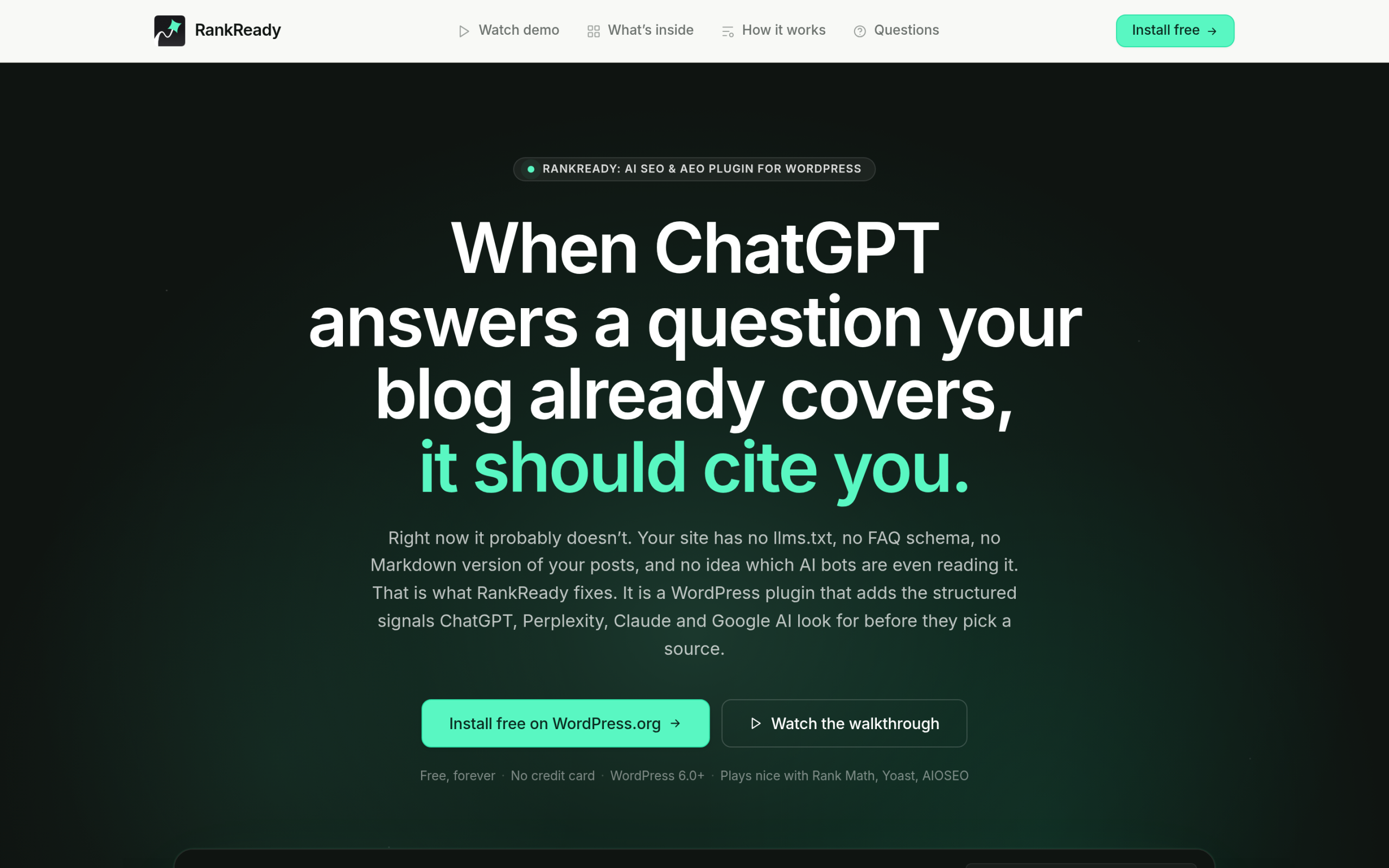
On WordPress, the structure and measurement steps are where a tool earns its place. RankReady is a free plugin that handles the discovery and measurement layer of AI SEO. It generates llms.txt and llms-full.txt files, adds a Markdown endpoint to every post, writes Article, Speakable, FAQPage, HowTo, ItemList, and Person schema, and manages 31 AI crawler controls synced to your robots.txt. It is free forever on WordPress.org, runs alongside Rank Math, Yoast, AIOSEO, and SEOPress, and keeps zero telemetry. It does not write your content for you, and that is the point: it removes the technical blockers so good content can get cited.
How to Measure AI SEO
The oldest rule in SEO still holds: you cannot improve what you cannot see. The problem is that Google Search Console does not tell you when ChatGPT quoted you or when an AI crawler read a page. AI SEO needs its own dashboard.
Three numbers tell the story. First, AI crawler activity: which bots like GPTBot and PerplexityBot visited, and what they read. Second, citation candidates: the pages AI systems fetched most in the last month, which hints at what they are likely to quote. Third, real AI referrals: actual visits sent from chatgpt.com, perplexity.ai, claude.ai, gemini.google.com, and copilot.microsoft.com. Together they turn AI SEO from a guess into something you can manage.
Start small. Pick your five most important pages, make them machine-readable, publish your llms.txt, and watch the crawler log for a month. The pages that get fetched and cited tell you exactly where to spend the next round of effort.
Suggested Reading
- Semantic SEO for WordPress: optimizing for meaning and entities
- Generative engine optimization (GEO): the 2026 guide
- How to optimize content for AI search, step by step
- Schema markup generator for WordPress
- E-E-A-T for AI search: building trust signals
