











The built-in metro patterns are fixed arrangements. If none of them puts the emphasis where your categories need it, you can write the pattern yourself.
You describe each tile’s size in order, and the block repeats your pattern down the listing.
For every Taxonomy Listing setting in one place, see the Taxonomy Listing guide.
Before You Start
- Edition: Pro — the Taxonomy Listing block needs Nexter Blocks Pro.
- Block to enable: Taxonomy Listing, switched on under Nexter > Blocks in your WordPress dashboard.
- Terms that exist. The block lists your real taxonomy terms, so a site with one category shows one card.
- A metro layout already chosen. The custom pattern is an option inside metro, not a layout of its own — see the metro layout doc first.
Steps
- Set the layout to metro, choose custom as the pattern, then enter your tile sizes and publish.
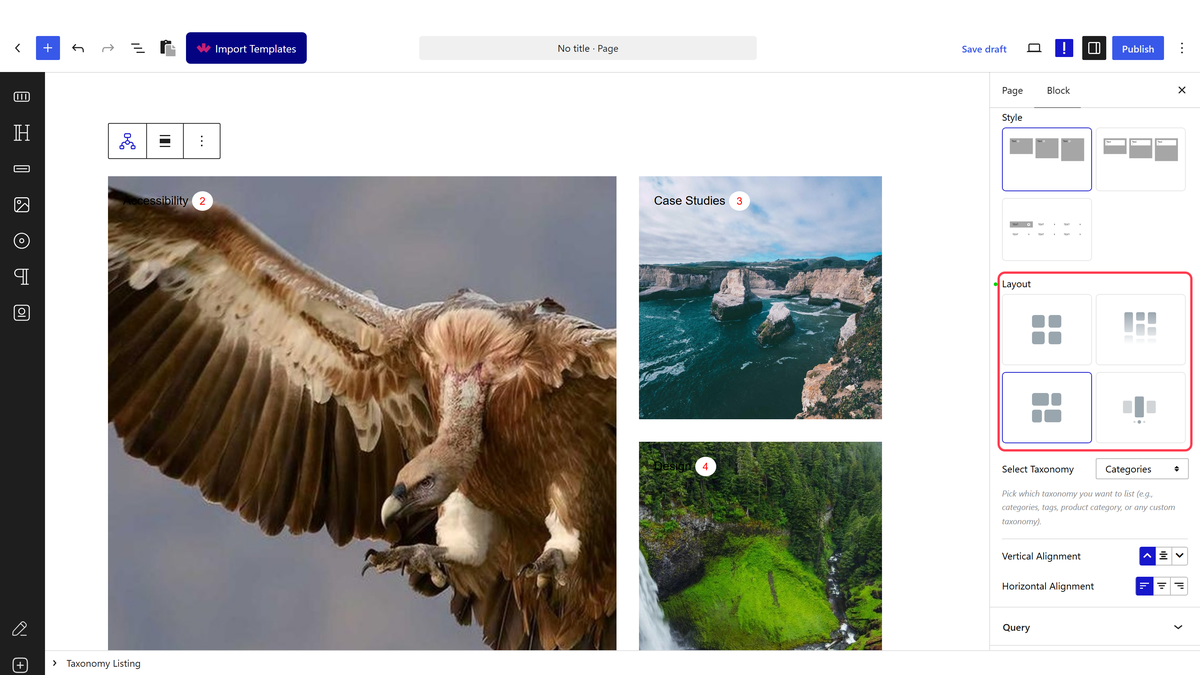
Tile sizes are separated by a space, a pipe and a space. A pattern of
2x2 | 1x1 | 1x1 | 1x2gives one large tile, two small ones and one tall one, then repeats.
How It Behaves
The pattern is parsed when the page renders and written onto the block, so you can confirm it took effect without guessing from the layout.
- The pattern is split on
|— space, pipe, space. Measured:2x2 | 1x1 | 1x1 | 1x2produced four numbered tile definitions in the block’s own data, in the order given. - Each breakpoint is independent. Measured with a custom pattern on desktop and the standard pattern on tablet and mobile, all three were recorded separately. Custom on one breakpoint does not force it on the others.
- The pattern repeats for as many terms as you show.
- Tiles are background images, as with any metro layout.
- Type a number into the item count; do not leave it blank. Measured on 5.0.6: a blank field renders one term rather than all of them, and so does
0. Reported to the developers. - Measured with Nexter Blocks Pro deactivated: the block renders nothing at all — not a wrapper, not a message, zero output. This is a Pro-only block.
Limitations
- Pro only — nothing renders with Pro deactivated.
- The separator is exact. Spacing around the pipe is part of the format, and a pattern written without it will not parse as you expect.
- The pattern is positional. It knows nothing about which category is which, so reordering terms changes which one gets the big tile.
- Your tile widths have to fit the column count. A
2x2tile in a two-column layout fills the whole row. - A pattern that does not divide into your term count leaves an uneven last row.
- Custom patterns need testing at every breakpoint. There is no preview that shows all three at once.
Troubleshooting
The pattern is being ignored
Check the separator: a space, a pipe, then a space. Also confirm that custom is selected for the breakpoint you are looking at, since each is set independently.
It works on desktop but not on mobile
Mobile has its own pattern setting. Choosing custom on desktop leaves the other breakpoints on whatever they were.
A tile is spilling across the row
Its width is larger than your column count allows. Reduce the tile width or raise the columns.
The big tile is on the wrong category
Tile sizes follow position. Reorder the terms so the right one lands in that slot.
The field’s own help text says to use a colon, not “x”
That in-editor hint is wrong. Measured on 5.0.6: a colon-separated pattern (as the hint suggests) is not split into tiles at all — it is stored as one unparsed string and nothing happens. The 2x2 | 1x1 format above is the one that actually works. Reported to the developers; use this doc’s format.
