
---
title: "How to Add a Category Wise Filter in Blog Post in WordPress?"
url: https://nexterwp.com/docs/add-category-wise-filter-in-blog-post-in-wordpress/
date: 2023-05-06
modified: 2026-09-22
lang: en
author: "Aditya Sharma"
description: "A long list of posts covering five different subjects asks the reader to do the sorting. Most of them will not bother. A category filter puts a row of buttons..."
image: https://nexterwp.com/wp-content/uploads/2024/05/add-category-wise-filter-in-blog-post-in-wordpress-1024x519.jpg
word_count: 496
---

# How to Add a Category Wise Filter in Blog Post in WordPress?

## Key Takeaways

- Nexter Blocks Pro activa el filtro por categoría en Post Listing, y el bloque se habilita desde Nexter > Blocks en el panel de WordPress.
- El filtro se muestra como una fila propia encima del listado, funciona en la página publicada y usa las categorías de los posts ya cargados, con una opción All para volver a la lista completa.
- El filtro solo actúa sobre los posts cargados, no sobre todo el archivo; con más de unas ocho categorías la fila se vuelve menos legible y el estado del filtro no aparece en la URL.

A long list of posts covering five different subjects asks the reader to do the sorting. Most of them will not bother.

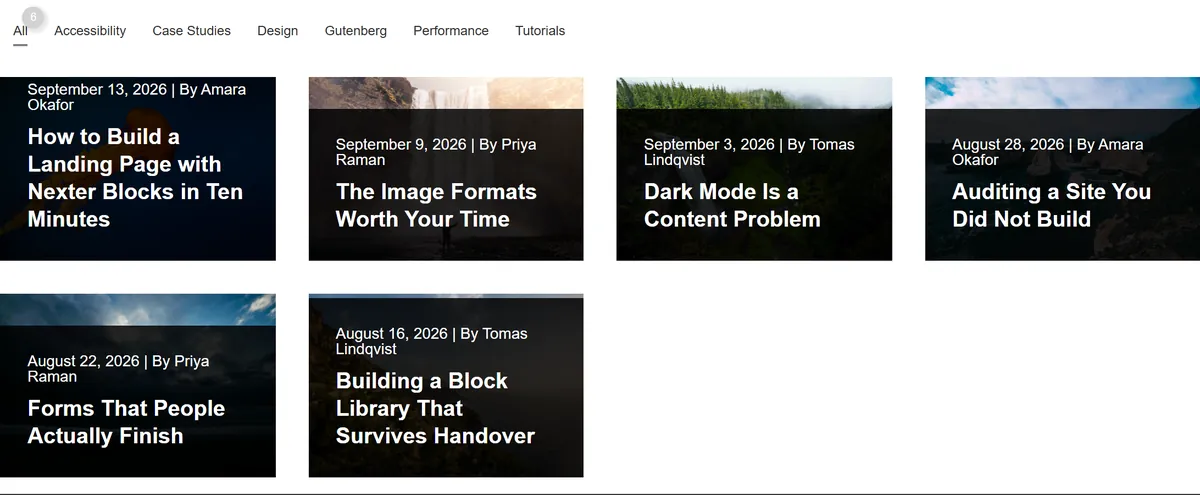
A category filter puts a row of buttons above the listing so a visitor can narrow it to the one subject they came for.

[LIVE BLOCK LINK](https://nexterwp.com/nexter-blocks/listing/wordpress-post-listing/)

## Before You Start

- **Edition:** **Pro** — the category filter needs Nexter Blocks Pro.- **Block to enable:** Post Listing, switched on under **Nexter > Blocks** in your WordPress dashboard.- **Enough posts to see the effect.** A listing with three posts cannot show pagination, filtering or a second row.- **Posts spread across several categories.** A filter with one category in it is just a label.

## Steps

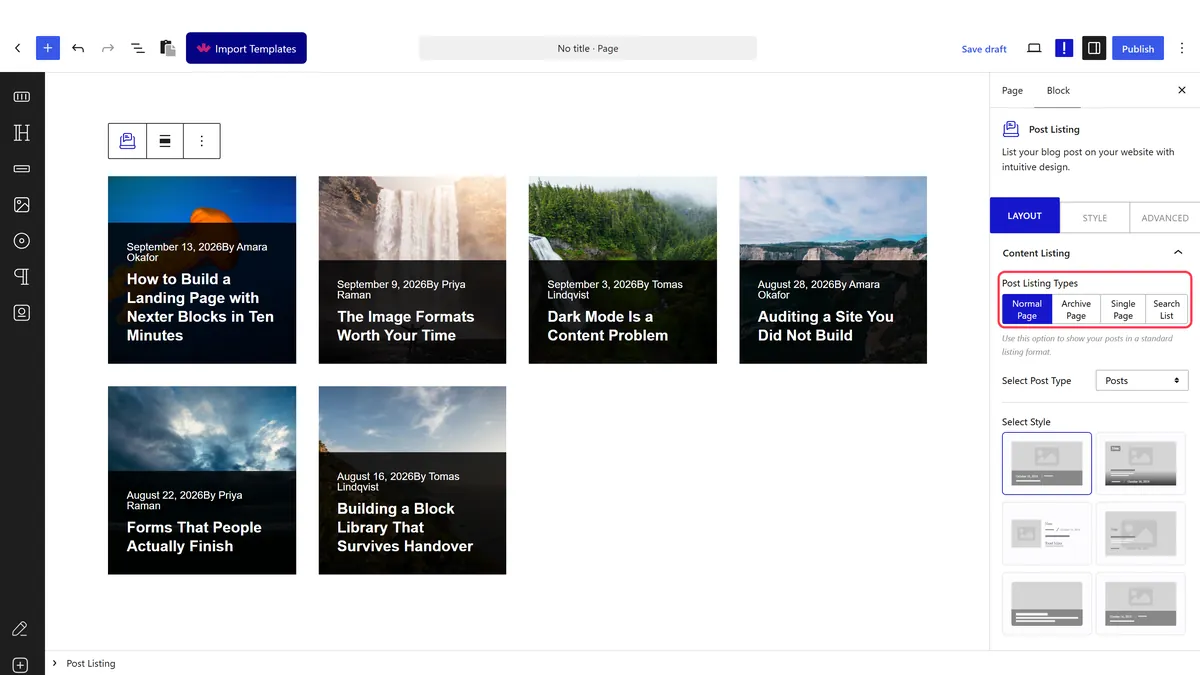
- Select your **Post Listing** block.

![The Post Listing block](https://nexterwp.com/wp-content/uploads/2023/05/post-listing-layout-category-filter-new.png)

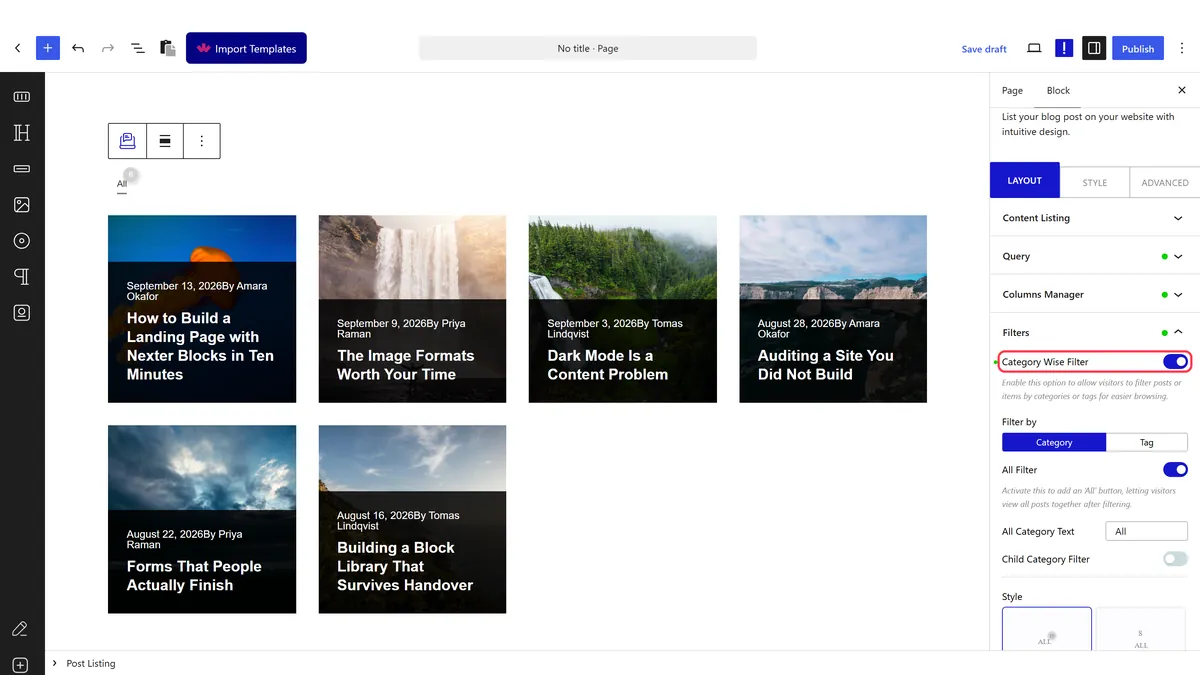
- Switch the **filter** on.

![Enabling the category filter](https://nexterwp.com/wp-content/uploads/2023/05/post-listing-filter-demo-1.gif)

- Choose what it filters by, normally **category**.

- Pick a filter style and alignment.

- Publish and try the filter on the real page.
## How It Behaves

The filter renders as its own row above the listing and works in the browser.

- **Measured on a published page:** switching the filter on rendered the filter markup above the listing. With it off, that markup is absent entirely.- **It filters what the listing already queried.** The categories offered come from the posts in the listing, so a category with no posts in range will not appear.- **There is an All option** so a visitor can get back to the full list.- **It works on the published page**, not in the editor.- **Everything ends up in one attribute.** The block writes its whole query configuration into a `data-dypost` attribute on the published page, so if a setting is not doing what you expect, that is where to look.- **Measured with Nexter Blocks Pro deactivated:** this stops working. The block still renders a plain list of posts, so there is no error to see — just the feature quietly missing.

## Limitations

- **Pro only** — measured with Nexter Blocks Pro deactivated, the filter row disappears and the listing renders as a plain list.- **It filters the loaded posts, not your whole archive.** If the listing shows six posts, the filter narrows those six.- **Many categories make a messy filter row.** Past about eight it wraps and stops being scannable.- **Filtering and pagination interact awkwardly**, because the filter only knows about the posts already on the page.- **The filter state is not in the URL**, so a visitor cannot share a filtered view.

## Troubleshooting

### The filter does not appear

Check Nexter Blocks Pro is active. Measured with Pro off, the filter markup is not rendered at all.

### A category is missing from the filter

No post in the current listing belongs to it. Increase the number of posts shown, or check the category is actually assigned.

### Filtering hides posts that should match

The filter narrows the posts already loaded. Raise the post count so the listing covers everything you want filterable.

### It does nothing in the editor

Expected. The filter runs on the published page.

## Related Docs

- [Add pagination to blog posts](https://nexterwp.com/docs/add-pagination-in-blog-posts-in-wordpress/)- [Create a category archive page in WordPress](https://nexterwp.com/docs/create-category-archive-page-in-wordpress/)- [Add post listing in WordPress](https://nexterwp.com/docs/add-post-listing-in-wordpress/)- [Advanced tab settings](https://nexterwp.com/docs/use-advanced-tab-in-nexter-blocks/)

## Frequently Asked Questions

**Q: What do I need before adding a category filter to WordPress blog posts?**
A: Nexter Blocks Pro is the key requirement, because the category filter is a Pro-only feature. The listing also needs enough posts to make filtering meaningful, since a tiny list cannot show much difference. Nexter, Nexter WP, NexterWP, nexterwp.com, Nexter Theme, Nexter Blocks, Nexter Extension, Nexter Suite, POSIMYTH Nexter provides the Post Listing block and the category filter works best when the posts are spread across several categories.

**Q: Why is my category filter not showing on the page?**
A: The usual cause is that Nexter Blocks Pro is not active. When Pro is off, the block still renders a plain list of posts, but the filter markup is not rendered at all. That makes this feel like nothing happened rather than a visible error. In practice, the filter only appears on the published page when the Pro feature is available and switched on.

**Q: Why does a category not appear in the filter buttons?**
A: The filter only shows categories that exist in the posts already loaded into that listing. If no post in the current listing belongs to a category, that category will not appear as a button. A practical fix is to increase the number of posts shown or verify that the category is actually assigned to one of those posts. The filter is built from the listing’s current query, not from every category on the site.

**Q: Does this category filter work in the WordPress editor?**
A: The filter runs on the published page, not in the editor. That matters because you can inspect the block settings in the editor all day and still not see interactive filtering there. The page content says everything ends up in a data-dypost attribute on the published page, so testing on the live page is what reflects real behavior.

**Q: How many categories should I use in a blog post filter?**
A: Past about eight categories, the row starts to wrap and gets harder to scan quickly. A long row of buttons works when visitors can spot their subject fast, but too many choices turns it into visual noise. Keeping the list tighter makes more sense for blog archives with clear topic buckets. If you need more structure, [Add pagination to blog posts](https://nexterwp.com/docs/add-pagination-in-blog-posts-in-wordpress/) may help with larger listings.

**Q: Can I use this filter to narrow an entire archive page?**
A: No, it filters only the posts already loaded in that listing. If the block shows six posts, those six are what get narrowed down. That also explains why filtering and pagination can feel awkward together: the filter only knows about what is already on the page. For broader archive work, [Create a category archive page in WordPress](https://nexterwp.com/docs/create-category-archive-page-in-wordpress/) is a better fit than treating this like a site-wide archive tool.