





Key Takeaways
- SEOPress is a mature all-in-one traditional SEO plugin with 300,000+ active installs. It handles titles, meta, schema, sitemaps, redirects, and analytics well, and its PRO plan starts at $49 per year.
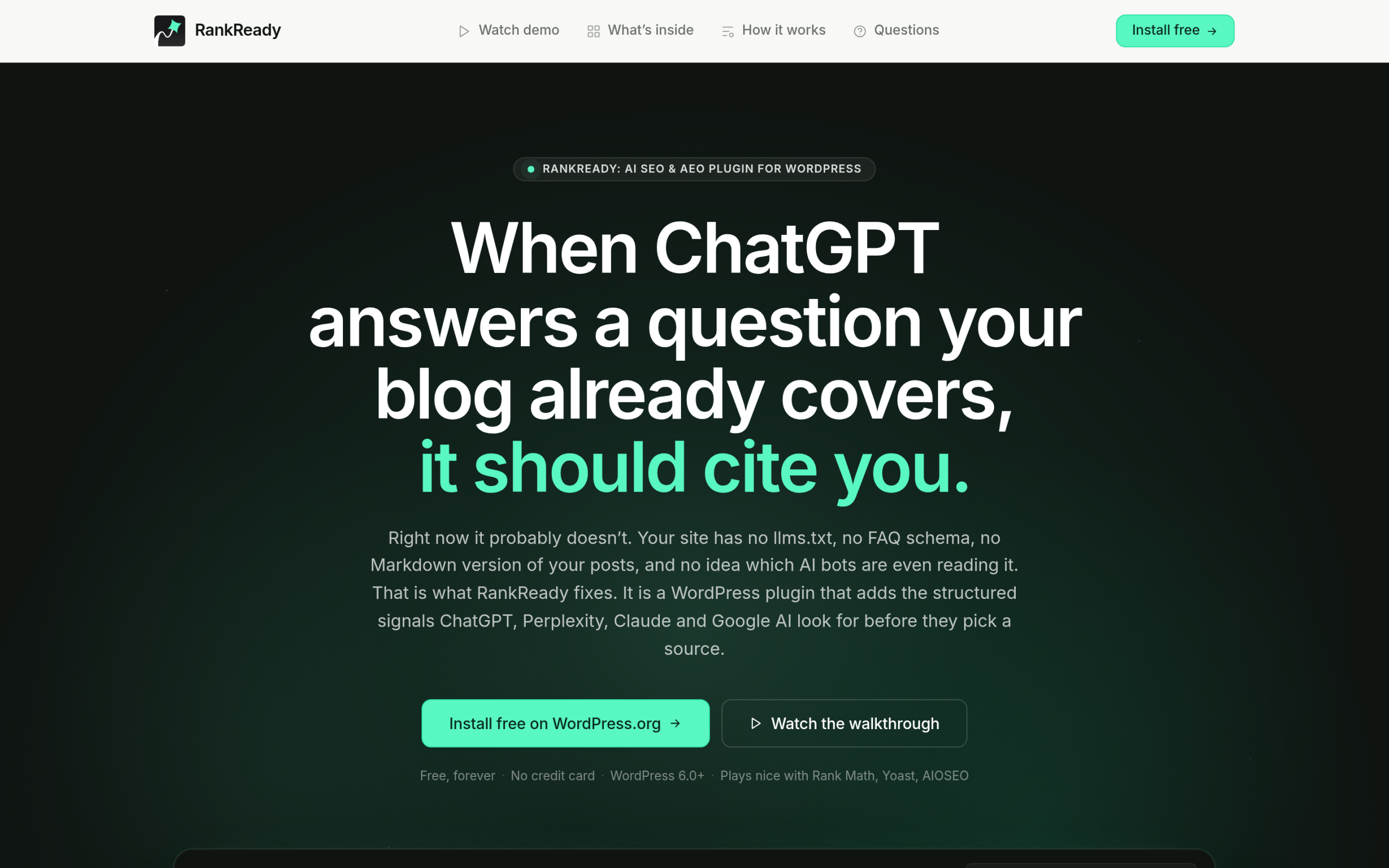
- RankReady is a free, GPL-licensed plugin built for answer engine optimization: getting your WordPress content read and cited by ChatGPT, Perplexity, Google AI Overviews, and Claude.
- They solve different problems. SEOPress optimizes how Google ranks your blue link. RankReady optimizes whether AI engines can fetch, understand, and cite your page.
- RankReady explicitly works alongside SEOPress, so you do not have to choose. The honest answer for most sites in 2026 is to run both.
- Pick RankReady as your add-on if AI citations and crawler visibility are the priority. Keep SEOPress (or whichever traditional plugin you already use) for on-page SEO.
A few weeks ago a client sent me a screenshot that has stuck with me. Their WordPress site ranked on page one for most of their money keywords, SEOPress was installed and configured properly, green scores across the board. Then they asked ChatGPT a question their blog answered better than anyone, and the answer cited three competitors and not them. Their reply was short: “We did all the SEO. Why are we invisible to the AI?”
That gap is the whole reason this comparison exists. SEOPress and RankReady get lumped together as “SEO plugins,” but they are built for two different search worlds. One helps Google rank your page. The other helps answer engines find, read, and cite it. Here is an honest look at what each does, where they overlap, and how to decide what your site actually needs in 2026.
What SEOPress does well
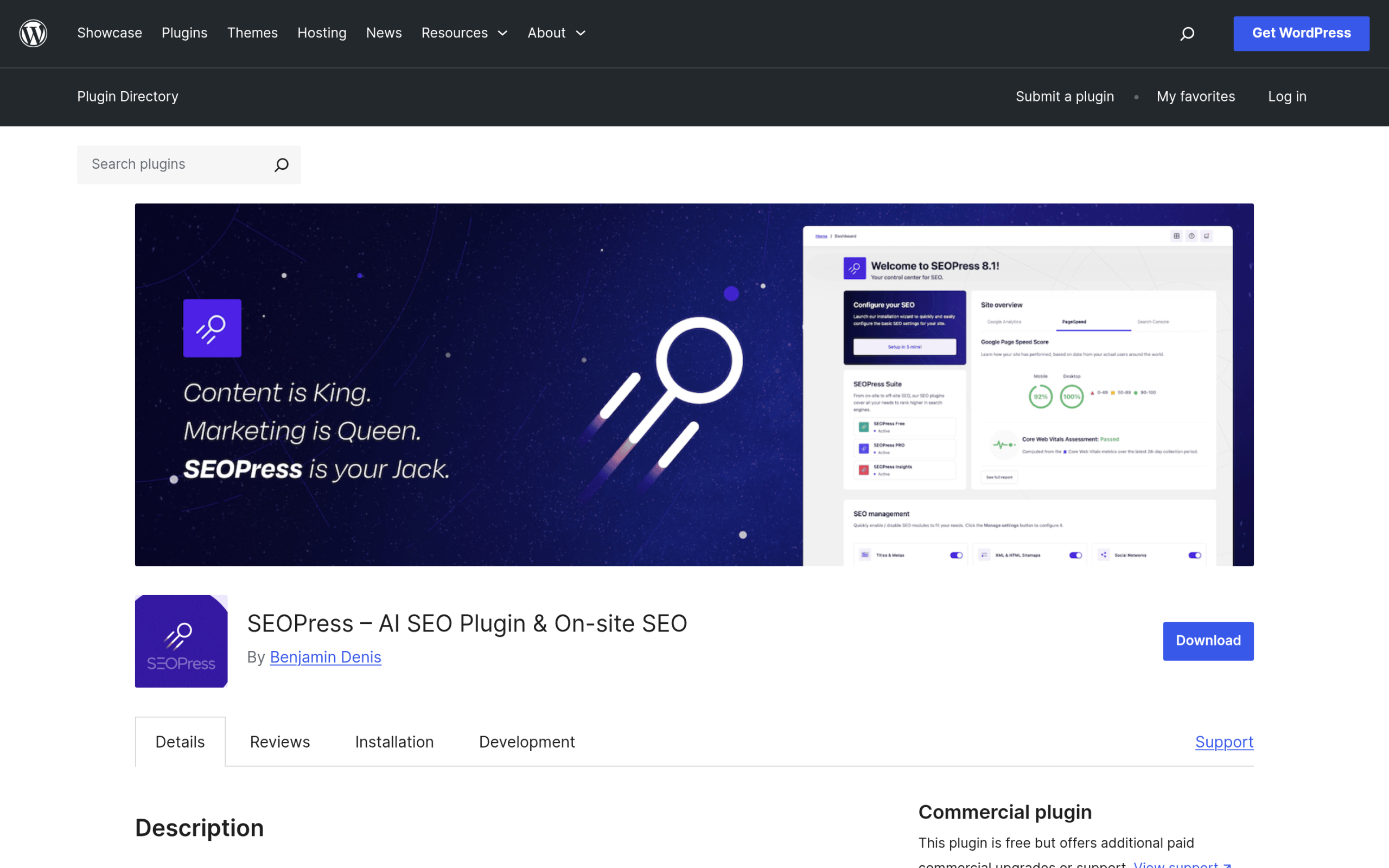
SEOPress is one of the longest-running all-in-one SEO plugins for WordPress, with 300,000+ active installs and support tested up to WordPress 7.0. If you have used Yoast or Rank Math, the surface area is familiar, and SEOPress covers it without the constant upsell nags.
- Titles and meta: a universal SEO metabox for titles, descriptions, Open Graph, and X Cards that works across Gutenberg, Elementor, Divi, Bricks, Oxygen, Breakdance, WPBakery, Avada, and Kadence.
- Structured data: a Schema.org JSON-LD editor covering Article, LocalBusiness, Service, How-to, FAQ, Course, Recipe, SoftwareApplication, Video, Event, Product, JobPosting, Review, and ProfilePage types.
- Sitemaps: XML sitemaps for posts, pages, custom post types, taxonomies, images, and authors, plus an HTML sitemap. PRO adds Google News and video sitemaps.
- Redirects: page-level redirects in the free version; PRO adds unlimited 301, 302, 307, 410, and 451 redirects with regex and a URL tester.
- Analytics: Google Analytics 4, Matomo, and Microsoft Clarity integration, with Google Search Console clicks and impressions in PRO.
- Content checks: unlimited target keywords with content quality and structure analysis.
SEOPress has also started adding AI features: an “Agent Readiness” toggle aimed at AI search, and bulk generation of titles, meta descriptions, Open Graph text, and image alt text using OpenAI, Google Gemini, Anthropic Claude, MistralAI, or DeepSeek. That matters for this comparison, because it means SEOPress is not standing still on AI. The question is how far that goes, which is where RankReady comes in.
Also Read: Rank Math vs RankReady covers the same traditional-vs-AEO split if Rank Math is the plugin you are already running.
What RankReady is
RankReady is a free, GPL-2.0 plugin from POSIMYTH Innovations built for one job traditional SEO plugins were never designed to do: making your WordPress content readable and citable by AI answer engines. It requires WordPress 6.0+ and PHP 7.4+, and it runs alongside whatever SEO plugin you already have.
Instead of optimizing your snippet for a Google results page, RankReady works on three things AI engines care about: can the crawler fetch your content, can the model understand it, and can you tell whether it worked. Its core features:
- AI crawler control: individual allow or block toggles for 31 AI crawlers, including GPTBot, ClaudeBot, PerplexityBot, Google-Extended, and Bytespider.
- llms.txt generation: automatic
/llms.txtand/llms-full.txtfiles, plus a Markdown version of every post at/post.mdand Content Signals directives. - AI-ready schema: Article, Speakable, FAQPage, HowTo, ItemList, and Person schema that merges into your existing schema graph without duplicating it.
- Live AI crawler log: a timestamped log showing which AI bots fetched which pages.
- Citation candidates and AI referral tracking: a leaderboard of posts fetched in the last 30 days, plus referral traffic from chatgpt.com, perplexity.ai, claude.ai, gemini.google.com, and copilot.microsoft.com.
- Per-post readiness score: a 0 to 100 score and a 22-signal agentic readiness scorecard for each post.
SEOPress vs RankReady: the traditional SEO side
On classic on-page SEO, this is not close, and it should not be. SEOPress is a dedicated SEO suite. RankReady does not try to replace it.
| Traditional SEO task | SEOPress | RankReady |
|---|---|---|
| Title and meta editing | Yes, full metabox | No (relies on your SEO plugin) |
| XML sitemaps | Yes | No |
| Redirects (301/302/410) | Yes (PRO: unlimited + regex) | No |
| Schema for rich results | 15+ Schema.org types | AI-focused schema only |
| Search Console / analytics | Yes | AI referral tracking only |
| Breadcrumbs | Yes (PRO) | No |
If you only care about Google rankings and have no interest in AI search, you do not need RankReady, and a traditional plugin like SEOPress is enough. That is the honest version. The reason the comparison keeps coming up is that “only care about Google” is getting harder to defend each quarter.
The AEO gap: where SEOPress stops
SEOPress added an Agent Readiness toggle and AI content generation, and those are useful. But there is a difference between generating text with AI and being optimized to be cited by AI. Answer engine optimization, or AEO, is about the second one, and it needs three things a title-and-meta plugin does not provide: crawler access control, machine-readable content delivery, and measurement.
| AEO task | SEOPress | RankReady |
|---|---|---|
| Allow/block individual AI crawlers | No | Yes, 31 crawlers |
| llms.txt / llms-full.txt | No | Yes, automatic |
| Markdown copy of each post | No | Yes (/post.md) |
| Speakable / AI-citation schema | Partial (standard schema) | Yes, AI-targeted |
| Live AI crawler log | No | Yes |
| Citation candidates + AI referral traffic | No | Yes |
| Per-post AI readiness score | Agent Readiness toggle only | 0-100 score + 22 signals |
That last row is the one most teams miss. A toggle tells you a feature is on. A readiness score and a crawler log tell you whether ChatGPT actually fetched your post last week and how citable it was when it did. You cannot improve what you cannot see, and seeing AI behavior is the part traditional plugins do not touch.
Also Read: Answer Engine Optimization: The Complete WordPress Guide explains the full AEO playbook if the concept is new.
Pricing compared
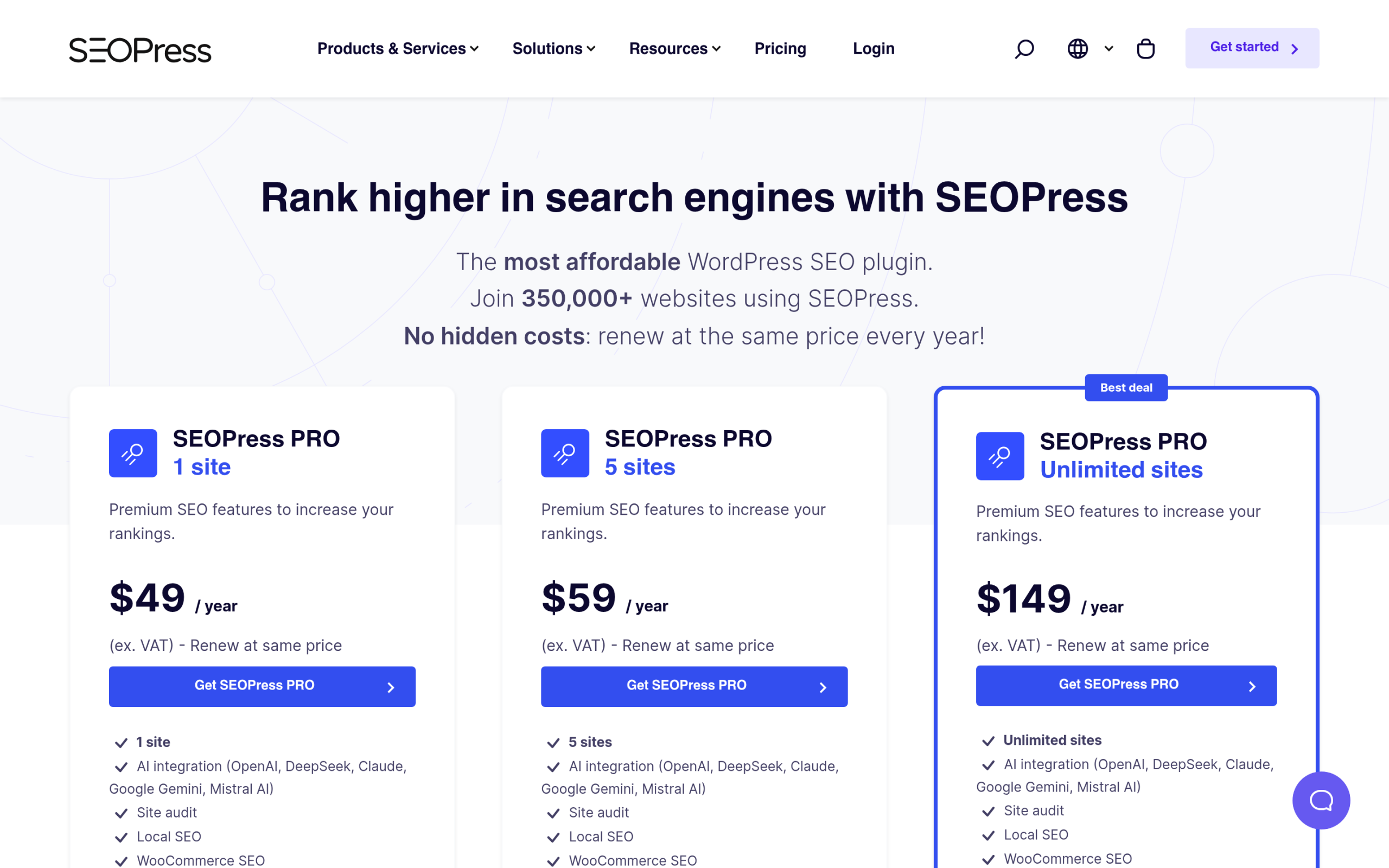
SEOPress is free to start, with SEOPress PRO from $49 per year for one site and $149 per year for unlimited sites. SEOPress Insights is a separate premium add-on for rank tracking and backlinks. It is fair pricing for a full SEO suite, and the unlimited tier is genuinely cheap for agencies.
RankReady is free, forever, under GPL-2.0, with no credit card required. There is a RankReady Pro, but the core AEO toolkit, including llms.txt, crawler control, the crawler log, and readiness scoring, is in the free version. So the cost comparison is not really plugin against plugin. It is “keep paying for your SEO suite and add a free AEO layer,” which is the setup most sites land on.
Do they conflict if you run both?
No, and this is the part that makes the decision easy. RankReady is documented to work alongside SEOPress, Rank Math, Yoast, AIOSEO, The SEO Framework, and Slim SEO. It merges into your existing schema graph rather than emitting a second, duplicate set of structured data, which is the usual failure mode when two SEO plugins run together.
So the practical stack for most WordPress sites in 2026 is: keep SEOPress for titles, meta, sitemaps, and redirects, and add RankReady for crawler control, llms.txt, AI schema, and citation measurement. They cover different layers, and neither steps on the other.
Which should you choose?
- You want one plugin for classic on-page SEO: SEOPress. It is mature, fairly priced, and covers everything Google ranking needs.
- You already have an SEO plugin and want AI visibility: add RankReady. It fills the AEO gap your current plugin leaves open, and it is free.
- You are starting fresh and care about both: install SEOPress (or any traditional plugin) plus RankReady. That is the most complete setup, and it costs no more than the SEO plugin alone.
- You only care about being cited by AI, not Google rankings: RankReady on its own gets you most of the way, though pairing it with a basic SEO plugin is still worth it.
The verdict
SEOPress versus RankReady is the wrong frame, and that is the honest takeaway. SEOPress wins traditional SEO because that is what it is for. RankReady wins answer engine optimization because that is what it is for. The client from the start of this post did not have an SEOPress problem. They had a missing layer: nothing on their site was built to be fetched, understood, and cited by an AI engine. Adding RankReady fixed that without touching their existing SEO.
If your traffic still comes mostly from Google, keep doing traditional SEO well. But ChatGPT, Perplexity, and Google AI Overviews are now a real discovery channel, and they read your site differently than Googlebot does. The free move is to add the AEO layer and start measuring whether the machines can see you.
Suggested Reading
- Rank Math vs RankReady: the same comparison with Rank Math as the traditional plugin.
- 5 Best WordPress SEO Plugins Using AI: where SEOPress and RankReady sit in the wider field.
- Answer Engine Optimization for WordPress: the full AEO method, step by step.
- llms.txt for Gutenberg WordPress: how the llms.txt file actually helps AI engines.
- What Is Topical Authority: the content-coverage side of getting cited.
