








Fonts shape how visitors read and respond to your content. Loading Google Fonts from Google’s servers adds an external request to every page load. If you use multiple font families, those requests multiply across every page your visitors view. Each request adds latency before text appears on screen and creates a dependency on a third-party server outside your control.
Self-hosting Google Fonts stores the font files directly on your web server. The browser loads fonts from your own server instead of reaching out to Google, which reduces page load time and removes the GDPR compliance concern that comes with transmitting visitor IP addresses to Google’s infrastructure.
With the Nexter Extension free plugin, you can self-host Google Fonts in WordPress without downloading files manually or writing custom CSS.
Learn via Video Tutorial

Why should you host Google Fonts locally?
When a WordPress site loads Google Fonts from Google’s CDN, each page load triggers a connection to an external server before the font files are retrieved. If your site uses several Google Font families, those connections add up on every page a visitor views. The additional network round-trip delays text rendering, which can raise your Largest Contentful Paint (LCP) time. LCP is a Core Web Vitals metric that affects Google Search rankings.
A locally-hosted font file loads directly from your own web server. The browser does not need to connect to a third-party domain, which removes the external dependency and speeds up font rendering. Whether your visitors are on fast broadband or a slower mobile connection, loading fonts locally reduces the number of separate server requests the browser must complete before the page is readable.
Self-hosting Google Fonts also addresses a GDPR compliance issue. When a visitor’s browser fetches Google Fonts directly from Google’s servers, it transmits the visitor’s IP address to Google. Courts in Germany and Austria have ruled this data transfer non-compliant with GDPR. Hosting the fonts locally prevents that transfer entirely, removing the need for consent notices specifically related to Google Fonts. If you want additional speed controls beyond font self-hosting, see Nexter Advance Performance Options Explained for the full set of performance tools in the Nexter Extension.
How to self-host Google Fonts with the Nexter Extension?
You can self-host Google Fonts in WordPress using a standalone plugin, or manually by downloading font files and serving them with custom CSS and @font-face declarations. If you are using the Nexter Extension plugin, the option is built in. No separate plugin or manual file handling is required.
From your WordPress dashboard, go to Nexter > Extensions > Performance.
Then go to the Google Fonts section, enable the toggle, and click on the gear icon (⚙).
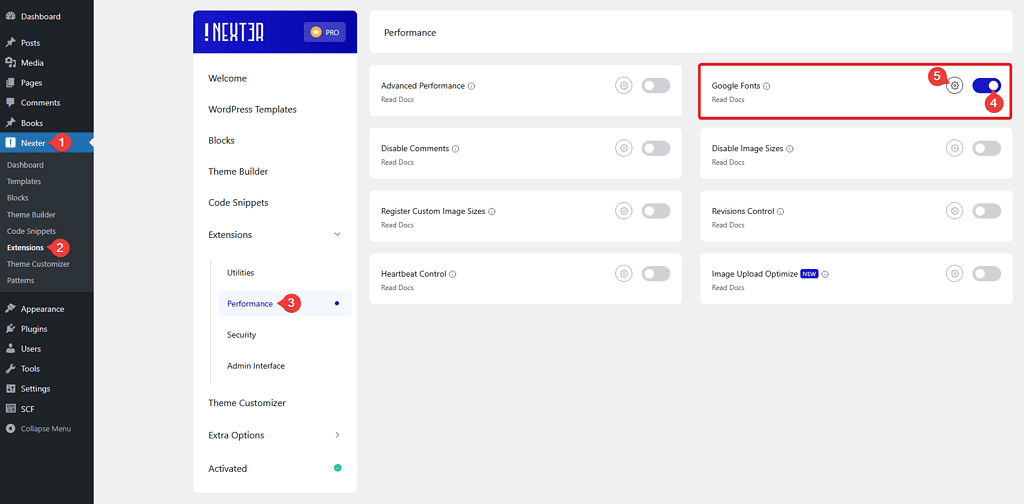
It will open the Google Fonts popup, where you will find the following options:
- Self-Host Google Fonts – Stores all Google Fonts used on your site on your own server instead of loading them from Google’s CDN. Use this when you want to reduce external font requests, improve page load time, or resolve GDPR compliance issues related to Google Fonts.
- Display Swap – Adds the
font-display: swapattribute to your Google Fonts declarations. This tells the browser to show a system font immediately and replace it with the Google Font once it finishes loading. Use this when you want to prevent a Flash of Invisible Text (FOIT), where page text stays invisible while the browser waits for the font file to download. This is a common cause of poor Cumulative Layout Shift (CLS) scores. - Disable Google Font – Stops Google Fonts from loading on your site entirely. Use this when you have switched to a different font source and no longer need Google Fonts to load at all. If you are switching to Adobe Fonts, see How to Use Adobe Fonts in WordPress for FREE?
- Clear Google Fonts – Deletes all locally stored Google Font files that were downloaded by the Self-Host Google Fonts feature. Click the Reset button to clear them. Use this when you want the Nexter Extension to re-download the latest font files after changing the fonts used on your site.
Enable the Self-Host Google Fonts toggle and click Save.
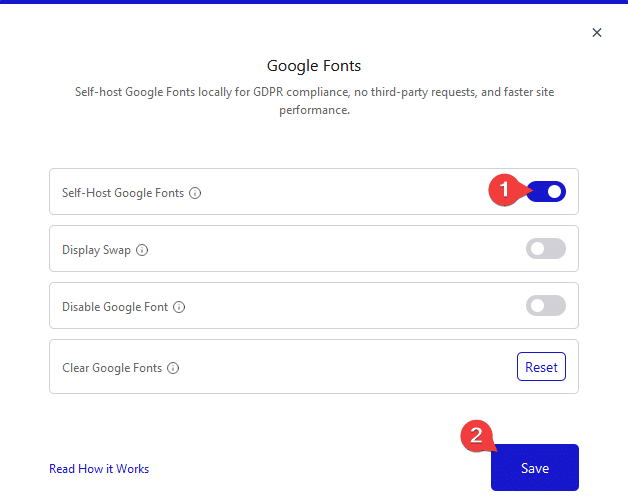
The Nexter Extension automatically downloads all Google Fonts currently in use on your site and serves them from your own server. No additional configuration is needed after saving.
If you want to use your own typeface instead of Google Fonts, the Nexter Extension also includes a built-in tool for uploading custom font files. See How to Upload Custom Fonts to WordPress for FREE?
Is Google Fonts Free to use on WordPress websites?
Yes, all the Google Fonts are open source and are free to use on WordPress websites, even for commercial purposes.
Is it Legal to Self-host Google Fonts in WordPress websites?
Google fonts are free to use in both commercial and non-commercial projects. And yes, it is safe to self-host Google Fonts locally in WordPress websites. Google Fonts is an open-source library of free web fonts, released under the Open Fonts License. This license allows web designers to use fonts from the Google Fonts library in their WordPress websites. Self-hosted Google Fonts are also easier to update and control, reducing the overall latency when loading pages, making them a great choice for professionals and amateurs alike.
