









Are you looking to create a custom footer template for your WordPress website? The footer is the bottom section of a website that typically contains copyright notices, contact information, and navigation links. Creating a custom footer template gives you full control over the layout and content of the footer across your entire site.
Best Used For:
- Business websites that need a consistent branded footer with links, social icons, and copyright text across all pages
- WooCommerce stores that need product-category links and payment method icons in the footer
- Portfolio and agency sites that need a distinct footer layout that reflects their visual identity
Requirement — This is a feature of the Nexter Extension (Free) plugin. Make sure it is installed and activated.
With the Nexter Theme Builder, you can create a custom footer template in WordPress without any coding knowledge.
To create a footer template using the Nexter Theme Builder, follow the steps:
1. From the Dashboard, go to Nexter Extension > Theme Builder > Add New Template.
2. In the popup, select Footer from the Select Template dropdown.
3. In the Name of Template field, add the template name.
After that, click on the Additional Settings link.
From the Footer Effects dropdown, select an effect for the footer. Here you will find three options:
- Normal — Creates a standard footer that sits at the bottom of the page.
- Fixed — Makes the footer fixed at the bottom of the browser window so it is always visible. Use this when you want a persistent contact button or legal link always in view.
- Zoom Out Effect — Adds a unique scroll animation to your footer. When a user scrolls down to the footer, the page container shrinks slightly with animation and the footer slightly overlaps the page container. You can also set a background color for when the page shrinks. Use this when you want a dramatic visual transition into the footer on scroll-heavy landing pages.
Select the footer effect that fits your needs.
4. Once done, click on the Next button.
5. On the next screen, set the display conditions.
From the Include In dropdown, select where the template will be visible.
From the Exclude From dropdown, set where the template will not show.
In both sections, you will find the same location options that are available in the header template.
6. Once done, click on the Create button.
7. The WordPress editor will open, where you can use WordPress blocks or Elementor to design the actual layout and content of the template.
To build the layout, use Nexter Blocks for the WordPress block editor or The Plus Addons for Elementor widgets for Elementor.
8. Once done, publish the template.
Your footer template is now active and will display according to the conditions you set.
Once your footer is in place, see also how to create a sticky header in WordPress to pair it with a fixed top navigation that matches your site.
Edit Footer Copyright Text of Nexter Theme
You cannot edit the default copyright text of the Nexter theme directly. To edit the footer copyright text in the Nexter theme, use a shortcode in the footer template.
For this, create a footer template as described above.
Then add the following shortcode.
[nxt-copyright][nxt-year]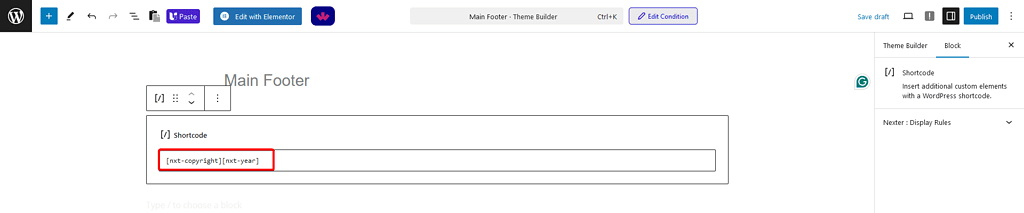
Here, [nxt-copyright] is for the copyright symbol, [nxt-year] is for the current year. You can also use [nxt-year format='d-m-Y'] to show the current date.Note: You can further customize the copyright text by adding custom text in between the shortcodes.
Also, check How to Create Header Template in WordPress for Free.
