





You change your WordPress theme and your entire site looks different overnight. You assign a different template to one page and only that page changes. Two buttons, two completely different outcomes. If you have ever pulled the wrong lever and ended up with a design mess to clean up, this guide is for you.
A WordPress theme controls the global design of your entire website. A template controls the layout of a specific page or content type within that theme. Both shape how your site looks, but at very different scales. Mixing them up leads to wasted hours of troubleshooting and customization that does not stick. This guide is for WordPress beginners, developers switching from other CMS platforms, and agency owners who build sites for clients and need to explain this clearly.
In this article, you will get plain-language definitions of both terms, a breakdown of the WordPress template hierarchy, a look at how block themes change the equation, and a side-by-side comparison of 6 key differences so you know exactly which tool to reach for and when.
What is a WordPress Theme?
A WordPress theme is a package of files that controls the visual identity and structural layout of your entire website. Activating a theme applies its design decisions, including typography, color palette, header and footer layout, sidebar behavior, and content spacing, to every page simultaneously.
Also Read: how to install a WordPress theme step by step.
Theme files typically include PHP template files (which determine layout structure), CSS stylesheets (which control appearance), JavaScript files (which handle interactivity), and configuration files. Together they tell WordPress how to render content across every page type: homepage, blog archive, single post, product page, and 404 error page.
You can only run one theme at a time. Switching themes changes your site’s design globally. The content, such as posts, pages, and media, stays exactly where it was. The design wrapping around that content changes completely.
Pros and Cons of Using WordPress Themes
Pros of Using Themes in WordPress
- Site-wide design control: One theme change updates the design of every page simultaneously, including headers, footers, colors, and typography. No page-by-page editing required.
- Thousands of options: WordPress.org lists 10,000+ themes, covering portfolios, blogs, WooCommerce stores, and business sites. Most offer one-click installation.
- No coding needed for basic customization: Most themes expose a visual customizer or block-based Site Editor where you can change colors, fonts, and layouts without touching code.
Cons of Using Themes in WordPress
- Heavy themes hurt performance: Feature-rich themes load large CSS and JavaScript files on every page, even when those features are not used. This directly increases page load time and hurts Core Web Vitals scores.
- Theme lock-in is real: Some themes bundle shortcodes, custom blocks, or proprietary widgets into page content. If you switch themes later, that content can break. Choose a theme that stores design in the theme, not in post content.
- Compatibility issues: Themes that are not updated regularly can conflict with newer versions of WordPress, Gutenberg, or popular plugins. Always check the “last updated” date before activating.
Nexter Theme, a lightweight WordPress theme by POSIMYTH, weighs under 50KB and runs zero jQuery, specs that keep it at the lighter end of the WordPress theme spectrum. It works with Gutenberg, Elementor, and Bricks Builder, making it a reliable foundation regardless of which builder you use.
Want a lightweight theme that works with any builder? Here is what makes Nexter Theme a fast, builder-compatible foundation for any WordPress site.
What is a WordPress Template?
A WordPress template is a file inside your theme that controls how a specific type of content is displayed. While your theme sets the global design, templates handle the layout for individual content types: a single blog post, a product page, a category archive, or a static page.
When a visitor opens a page on your site, WordPress automatically selects the right template for that content type. You do not have to do anything manually for this to work. WordPress follows a built-in decision system called the template hierarchy, which is covered in detail in the next section.
Templates are especially useful when you need a specific page to look or function differently from the rest of your site. A landing page without a sidebar and header, a portfolio page with a masonry grid, or a product page with a full-width image layout all require template-level changes, not theme-level changes.
What Types of WordPress Templates Exist?
WordPress templates cover every content type on your site. The most common ones include:
- Single post template (single.php): Controls the layout of individual blog posts. This is the most commonly customized template on content sites.
- Page template (page.php): Controls the layout of static pages. Most themes include variants like full-width, no sidebar, or landing page layouts that you can assign per page.
- Archive template (archive.php): Controls how category pages, tag pages, and date-based archives display their list of posts.
- Custom page templates: Manually created templates that a theme developer registers, allowing users to assign them to any specific page from the WordPress editor sidebar.
- WooCommerce templates: Dedicated templates for the shop page, single product, cart, and checkout. These can be customized independently of your main theme design.
Template Kit vs Theme: What Is the Difference?
A template kit (also called a starter template or template pack) is a collection of pre-designed page layouts for a specific niche or style. Unlike a theme, a template kit does not change your global design settings. You import the pages from the kit into your existing theme, typically through a page builder or importer plugin.
Use a template kit when you want to build a full site quickly without starting from a blank page. Use a theme when you want to set the foundational design system that applies across everything. The two are not competitors. They work together.
The Nexter ecosystem includes 1,000+ starter templates for Gutenberg that import with one click and work inside any active theme, including Nexter Theme.
Pros and Cons of Using Templates in WordPress
Pros of Using Templates in WordPress
- Page-level design control: Templates let you create a completely different layout for one page without touching any other page on your site. Landing pages, sales pages, and portfolio pages commonly use custom templates.
- Content-type flexibility: You can display blog posts, product pages, and category archives with separate layouts optimized for each content type, improving readability and conversion on each page type.
- Logical site structure: Using dedicated templates for different content types helps visitors naturally navigate your site. A blog post template can show related articles; a product template can show reviews and related products.
Cons of Using Templates in WordPress
- Limited by your theme: The templates available to you depend on what your active theme provides. Themes that include few templates limit your layout options unless you add a theme builder plugin.
- Technical knowledge for custom templates: Creating a new template file from scratch requires understanding PHP, HTML, and the WordPress template hierarchy. Most users rely on theme builders to avoid this.
- Risk of visual inconsistency: If multiple custom templates are used across a site without a unified design system, the result can feel disjointed. Establish a design system in your theme before creating per-page templates.
Want to create custom templates for any content type without writing PHP? Here is how Nexter Extension’s Theme Builder handles it visually.
What is the WordPress Template Hierarchy?
The WordPress template hierarchy is the built-in priority system WordPress uses to decide which template file to load for every page request. WordPress checks for the most specific template first and falls back to increasingly general files until it finds one that exists.
Here is how WordPress selects a template for a single blog post:
- single-{post-type}-{slug}.php (e.g., single-post-my-review.php)
- single-{post-type}.php (e.g., single-post.php)
- single.php
- singular.php
- index.php
WordPress walks this list from top to bottom. The first file it finds in your active theme is the one it uses. Every WordPress theme ships with at least an index.php as the universal fallback, which is why any theme can display any content type even if it does not have dedicated template files for each one.
Understanding the template hierarchy matters most when you want different page types to look different. For example, if you want your portfolio posts to display without a sidebar but your blog posts to include one, you need separate template files for each post type. Using a visual theme builder like Nexter Extension’s Theme Builder (Pro) lets you create these per-type templates through a drag-and-drop interface, without editing any PHP.
What is a Block Theme in WordPress (and How It Changes Templates)?
WordPress 5.9 introduced Full Site Editing (FSE) and with it, a new category of theme called a block theme. Block themes change how templates work in two significant ways compared to classic themes.
Templates become HTML files instead of PHP files. In a classic theme, templates are PHP files (single.php, archive.php) that mix WordPress functions with HTML markup. In a block theme, templates are HTML files made entirely of block markup. There is no PHP in a block theme template. This makes them easier to edit visually but changes how developers extend them.
The entire site is editable through the Site Editor. Headers, footers, sidebars, template parts, and individual page templates can all be modified through the WordPress block editor without leaving the dashboard. No Customizer, no code editor. This is a major shift for users who previously needed Elementor Pro or a dedicated theme builder to build headers and footers visually.
If you run a classic theme today, none of this changes how you work right now. Classic themes still use PHP templates and the WordPress Customizer. Block themes are the direction WordPress is heading, but classic themes are fully supported and receive updates alongside them.
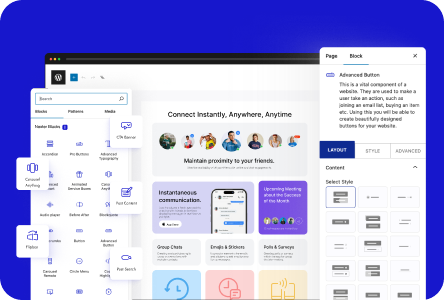
Nexter Theme is built to work alongside both workflows. Nexter Blocks, a Gutenberg block plugin by POSIMYTH with 90+ native blocks, works with all WordPress themes regardless of whether they are classic or block-based. This means your blocks and layouts survive a theme switch.
WordPress Theme vs Template: 6 Key Differences
The theme vs template distinction comes down to scope and specificity. Here is a side-by-side view before the detailed breakdown:
| Feature | WordPress Theme | WordPress Template |
|---|---|---|
| Scope | Entire website | One page or content type |
| Function | Sets design foundation | Controls page layout |
| File type (classic) | Folder of PHP, CSS, JS files | Single PHP file inside theme |
| File type (block) | Folder of HTML, CSS, JSON files | Single HTML file inside theme |
| Customization tool | Customizer or Site Editor | Template Editor or theme builder |
| Switching impact | Changes entire site design | Changes one page or content type |
| Best for | Global branding decisions | Per-page layout needs |
1. Scope: Site-Wide vs Page-Level
A theme covers your entire website. Activate Nexter Theme and its typography, color system, header layout, and footer structure apply to every URL on your domain. There are no exceptions. Themes set the rules for the whole site.
A template has a much narrower focus. It controls the structure of a specific page type: a single blog post, a product page, or your 404 error page. If you modify single.php, only single post pages change. Nothing else on the site is affected.
2. Function: Design Foundation vs Layout Engine
Themes function as the design foundation. They answer the question: what does this site look and feel like? Typography scale, spacing units, brand colors, and the overall visual rhythm all live in the theme.
Templates function as layout engines. They answer the question: how is content arranged on this particular page? Where does the title go relative to the featured image? Does this page have a sidebar? Does the content column span the full width? These decisions live in templates, not the theme.
3. File Structure: Folders vs Individual Files
A theme is a folder inside wp-content/themes/ that contains multiple files working together. A minimal classic theme needs at minimum two files: style.css (which registers the theme with WordPress) and index.php (the universal template fallback). Production themes contain dozens of files covering every content type.
A template is a single file inside that theme folder. The theme folder is the house. Templates are the rooms inside it. You cannot have a template without a theme any more than you can have a room without a building around it.
4. How You Customize Each One
Themes are customized through the WordPress Customizer (classic themes) or the Site Editor (block themes). These interfaces expose theme settings such as logo upload, color palette, font selection, and layout widths. No code required for most changes.
Templates are customized in the template file itself, either by editing the PHP or HTML directly, or by using a visual theme builder. The Nexter Extension Theme Builder (Pro) provides a drag-and-drop interface for creating and editing templates for any content type, with 50+ display conditions to control exactly when each template loads. No PHP editing required.
5. What Happens When You Switch
Switching themes is a site-wide event. Every page immediately reflects the new theme’s design. Your content (posts, pages, media) is safe because WordPress stores content in the database separately from theme files. But any customizations you made inside the old theme’s Customizer panels are lost when you switch to a different theme.
Switching or changing a template only affects pages assigned to that template. Change your single post template and your blog posts get a new layout. Your homepage, archive pages, and product pages remain exactly as they were.
One important nuance for Gutenberg users: if your blocks are added to page content using Nexter Blocks, those blocks travel with the content through a theme switch. Nexter Blocks are not theme-dependent. Your block layouts survive even if you switch from Nexter Theme to a completely different theme. This is unlike some page builder content that becomes locked to a specific theme ecosystem.
6. Builder-Specific Considerations
Different page builders handle the theme vs template distinction differently, and understanding this can save you hours of troubleshooting.
Gutenberg (native WordPress editor): Classic themes use PHP template files. Block themes use HTML template files editable through the Site Editor. Nexter Blocks works with both, providing 90+ native Gutenberg blocks that render the same way regardless of which theme type is active.
Elementor: Elementor Pro includes a Theme Builder that creates templates for headers, footers, and content types. These templates live inside Elementor’s system, not inside your theme’s file folder. The Plus Addons for Elementor, a companion plugin from POSIMYTH with 120+ Elementor widgets, extends what you can build inside these Elementor templates without needing a heavier theme.
Nexter Extension (all builders): Nexter Extension’s Theme Builder works independently of your active theme and creates templates for any content type through a visual interface. It is compatible with Gutenberg, Elementor, and Bricks Builder. For agencies using WDesignKit, templates built in one builder can be converted and reused across builders with the one-click widget converter.
Using Gutenberg and want to extend your template layouts? Here is what Nexter Extension’s 50+ features add to the native WordPress editor.
Stay updated with Helpful WordPress Tips, Insider Insights, and Exclusive Updates – Subscribe now to keep up with Everything Happening on WordPress!
Wrapping Up: Which Should You Use, a Theme or a Template?
Understanding the difference between a WordPress theme and template gives you direct control over your site’s design at both the global and page-specific level.
Choose a new theme when you want to change your site’s entire visual identity: its brand colors, typography system, header and footer structure, and design language. Choose a different template (or create one) when you want a specific page or content type to have a different layout from the rest of your site without touching anything else.
For most WordPress sites, the practical workflow looks like this: activate a lightweight, fast theme as your foundation, then use templates to create distinct layouts for your homepage, blog posts, landing pages, and product pages. A Gutenberg plugin like Nexter Blocks, built by POSIMYTH with 90+ native Gutenberg blocks and 1,000+ starter templates, covers both sides of this workflow. The theme handles the design system. The blocks handle the layout of individual content sections. Explore Nexter Pro plans to see which tier fits your site count and workflow.
Get Exclusive WordPress Tips, Tricks and Resources Delivered Straight to Your Inbox!
Subscribe to stay updated with everything happening on WordPress.
