



All three of these plugins do the same core job: make a WordPress site multilingual. The differences that actually matter show up in pricing, translation method, and how much of the process is automated versus manual. Here’s the breakdown with current, live-checked pricing and features for all three.
WPML: The Established, Paid, Feature-Complete Option
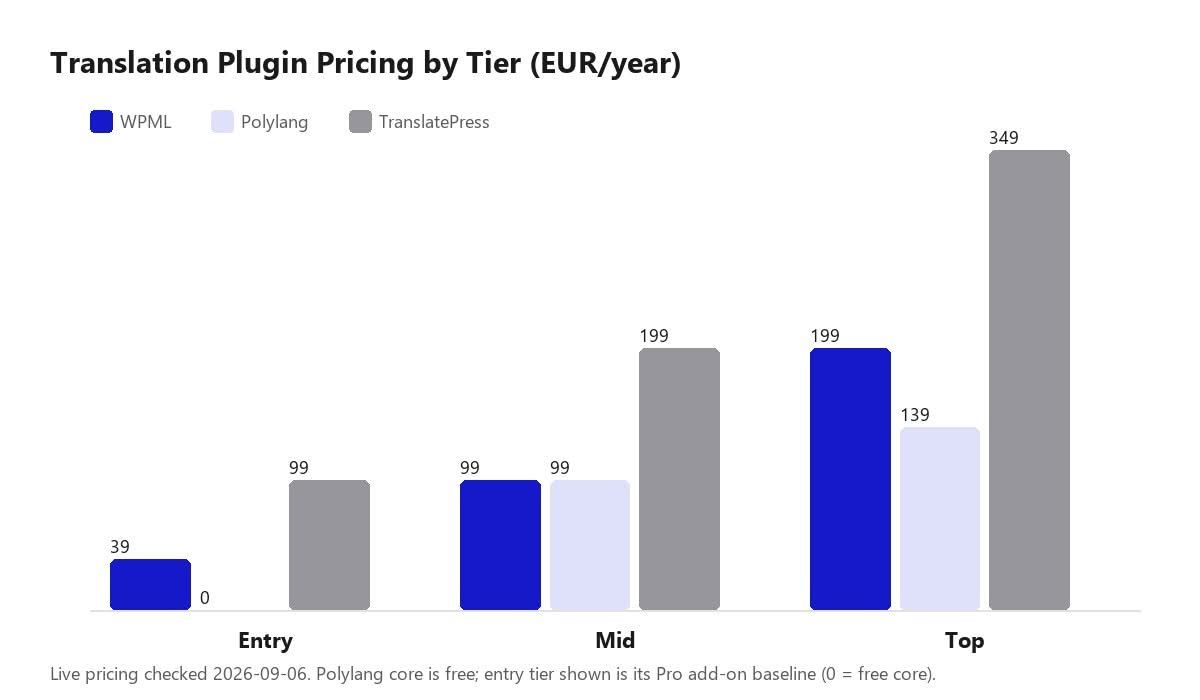
WPML is a paid, premium-only plugin (no free tier) with three plans: Multilingual Blog at €39/yr (basic translation via the WordPress editor only, no page-builder support, no e-commerce, no Full Site Editing support), Multilingual CMS at €99/yr (adds the Advanced Translation Editor, string translation, page-builder support, WooCommerce support, and 90,000 AI translation credits), and Multilingual Agency at €199/yr (the same feature set as CMS but with 180,000 AI credits and unlimited site activations instead of 3 production/9 development sites). All three tiers include a year of support and updates and a 30-day money-back guarantee.
The entry Blog plan is a real trap for anyone building on Elementor or a similar page builder: it explicitly excludes page-builder support, e-commerce translation, and Full Site Editing support, all of which require jumping to the €99/yr CMS plan. Most real WordPress sites need the CMS tier or higher.
Polylang: The Free-First, Modular-Pricing Option
Polylang’s free version, available on WordPress.org, covers the core multilingual structure: assigning a language to posts, pages, categories and tags, and a language switcher, with community support only. Beyond that, Polylang prices its Pro features as three separate purchasable products rather than one tiered ladder: Polylang Pro at €99/yr (custom post types and taxonomies, menu and widget translation, subdirectory/subdomain/separate-domain setups, XLIFF import/export, premium support), Polylang for WooCommerce at €99/yr (WooCommerce-specific translation: products, Shop/Cart/Checkout pages, order emails, HPOS support), and the Polylang Business Pack at an introductory €139/yr (normally €198) that bundles Pro and WooCommerce together plus DeepL machine-translation integration.
This modular structure is the practical distinction from WPML and TranslatePress: a content-only blog with no store can get everything it needs from the free version plus the €99/yr Pro add-on, without paying for WooCommerce features it will never use.
TranslatePress: The Visual, AI-Word-Metered Option
TranslatePress’s signature feature is a visual, front-end translation editor — you translate directly on a live preview of the page rather than in a separate admin screen. Its three paid tiers are Personal at €99/yr (1 site, 50,000 AI-translated words included), Business at €199/yr (3 sites, 200,000 AI words, plus add-ons for translator accounts, a different domain per language, and automatic user-language detection), and Developer at €349/yr (unlimited sites, 500,000 AI words, every current and future Pro add-on).
The word-count metering is the detail worth understanding before buying: AI translation runs on a consumable word allowance per year, not an unlimited feature, so a large multilingual site translating substantial new content monthly can burn through 50,000 words faster than the plan name suggests.
Also Read: Multilingual SEO for WordPress — whichever plugin you pick, the SEO setup (hreflang, sitemaps per language) follows the same principles.
Pricing Side by Side, at Comparable Tiers
| Plugin | Entry paid tier | Mid tier | Top tier | AI/machine translation included? |
|---|---|---|---|---|
| WPML | €39/yr (Blog, limited) | €99/yr (CMS, most popular) | €199/yr (Agency, unlimited sites) | 90,000–180,000 credits from the CMS tier up |
| Polylang | Free (core structure) | €99/yr (Pro or WooCommerce, separately) | €139/yr intro (Business Pack, both bundled) | DeepL integration on Business Pack only |
| TranslatePress | €99/yr (Personal, 1 site) | €199/yr (Business, 3 sites) | €349/yr (Developer, unlimited) | 50,000–500,000 AI words/yr, metered by tier |
How Each One Stores Translations Under the Hood
WPML and Polylang both work by creating a genuinely separate WordPress post for each language, linked together as a translation group — your French homepage is its own post in the database, distinct from the English one, each independently editable and each with its own URL. TranslatePress works differently: it stores translated strings in its own database tables layered over your original content, rather than duplicating the post itself. This isn’t just a technical curiosity — it affects workflow. The separate-post model (WPML, Polylang) means a translator can open a distinct edit screen per language, and each language version can technically drift structurally from the others. The overlay model (TranslatePress) is why its visual, on-page editor works the way it does: you’re translating strings in place on the live page rather than switching between separate post-edit screens.
URL Structure and Hreflang: The Technical SEO Layer That Matters Regardless of Plugin
All three plugins support the standard multilingual URL patterns — subdirectories (/en/, /de/), subdomains (en.example.com), or separate domains — and subdirectories are the generally recommended default across all of them, since they consolidate domain authority under one root domain rather than splitting it across subdomains. Where the three genuinely differ is how completely they handle hreflang out of the box. WPML automatically generates hreflang tags for every page with a translation, including the x-default tag pointing to your default-language version, with no separate add-on required. Polylang covers the hreflang basics in its core feature set too, though with less depth than WPML’s implementation. TranslatePress is the outlier here: full hreflang support and translated URL slugs require its separate SEO Pack add-on rather than being included in the base plugin, which is worth budgeting for if multilingual SEO (not just multilingual UX) is the actual goal.
Also Read: Multilingual SEO for WordPress — the full hreflang, sitemap, and canonical-tag setup process, which applies on top of whichever plugin you choose here.
How to Actually Choose
- Content-only site, no store, budget-conscious — Polylang free, or add Polylang Pro (€99/yr) once you need custom post type or menu translation.
- Running WooCommerce and want machine translation with a visual, on-page editor — TranslatePress Business (€199/yr), watching the AI word allowance against your actual content volume, and budgeting for the SEO Pack add-on if hreflang and translated slugs matter to you.
- Large or agency-managed site needing the deepest page-builder and plugin compatibility testing — WPML CMS or Agency (€99–€199/yr); its market share means more third-party plugins are explicitly tested against it, and hreflang is handled automatically with no extra purchase.
Also Read: Nexter Theme Global Styles: How to Set Up Brand Colors, Fonts and Spacing Sitewide — Nexter Theme’s own RTL and multilingual layout support pairs with any of these three.
Conclusion
None of these three plugins is objectively “best” — each optimizes for a different constraint: WPML for the deepest third-party compatibility testing and automatic hreflang, Polylang for a genuinely free starting point with modular paid add-ons, TranslatePress for a visual editor paired with metered AI translation and an SEO layer that costs extra. Match the choice to your actual site (whether you run WooCommerce, how much new content you translate per year, and your compatibility and SEO needs), not to whichever plugin has the most reviews.
FAQ
Is any of these three free?
Polylang has a genuinely free core version on WordPress.org. WPML is premium-only with no free tier. TranslatePress’s free version exists but is limited to one additional language with no automatic translation.
Which one is cheapest for a WooCommerce store?
At list price, Polylang’s WooCommerce add-on (€99/yr) or the Business Pack (€139/yr intro) undercuts both WPML’s CMS tier (€99/yr, though it bundles more than just WooCommerce) and TranslatePress Business (€199/yr) for a single-site store, though exact value depends on which specific features your store actually needs.
Can I switch between these plugins later?
Migrating multilingual content between these plugins is possible but non-trivial, since each stores translated content differently — WPML and Polylang as separate linked posts, TranslatePress as string overlays in its own tables. It’s worth deciding carefully upfront rather than planning to switch later.
Which one handles hreflang tags automatically without an add-on?
WPML generates hreflang tags (including x-default) automatically at every tier. Polylang covers the basics in its core feature set. TranslatePress requires its separate SEO Pack add-on for full hreflang support and translated URL slugs.
Suggested Reading
- Multilingual SEO for WordPress
- Nexter Theme Global Styles: How to Set Up Brand Colors, Fonts and Spacing Sitewide
- Custom Fields in WordPress: Native Fields vs ACF vs Block Bindings
