










Key Takeaways
- Programmatic SEO, generating many pages from one template plus a dataset, is not banned. Google penalizes it only when pages exist to rank instead of to help users.
- Google’s scaled content abuse policy targets pages “generated for the primary purpose of manipulating search rankings and not helping users” (updated 2026-05-15).
- The line is value per page: unique data, real search demand, and content a human would find useful with the search engine removed.
- On WordPress, build it safely with a custom post type for the data plus one Gutenberg template (Nexter Blocks dynamic content and Display Conditions), published in reviewed batches.
- Add valid schema and check readiness with a tool like RankReady, but remember a thin page with perfect schema is still a thin page.
A WordPress owner I traded messages with last spring did everything the programmatic SEO playbook told him to. He built one page template, wired it to a spreadsheet of roughly 2,000 city names, and generated a “plumber in [city]” landing page for every row overnight. For about five weeks the traffic graph looked like a ski jump. Then a Google update rolled through and the entire set dropped to zero. Not warned, not throttled. Gone from the index.
His takeaway was that programmatic SEO is dead. It isn’t. His pages died because they were 2,000 copies of one page with a city name swapped in, and nothing else on the page changed. That is the exact pattern Google now files under “scaled content abuse.” The method that generates pages from a template and a dataset is still fine. The web runs on it. Zillow, Yelp, and every comparison site you have ever used are programmatic. What changed is that Google got very good at telling the difference between a page that answers a real question and a page that only exists to catch a keyword.
This is a WordPress-specific guide to building programmatic pages that land on the right side of that line: what the practice actually is, the policy language that decides who gets deindexed, and how to build and structure the pages in WordPress so each one earns its spot.
What programmatic SEO actually is
Programmatic SEO is the practice of creating many pages from a single template plus a structured dataset, instead of writing each page by hand. You build the template once, point it at a data source (a spreadsheet, a database, a set of custom fields), and every row becomes a page.
The classic shape is a “modifier plus head term” pattern: [city] + coworking spaces, [language] + to + [language] + translation, best + [tool] + alternatives. Each combination maps to a real thing people search for, and each page is meant to answer that one query better than a generic page could. On WordPress this usually means a custom post type holding the data, and a template that reads the fields and renders them into a consistent layout.
The technique is neutral. It is a production method, like a printing press. Whether it helps or hurts your site comes down to one question that Google has now written into policy: does each generated page add value for the person who lands on it, or does it only exist to rank?
Also Read: What Is a Custom Post Type in WordPress? Custom post types are the container almost every programmatic build sits on, so it helps to understand them first.
Why Google started deindexing programmatic pages
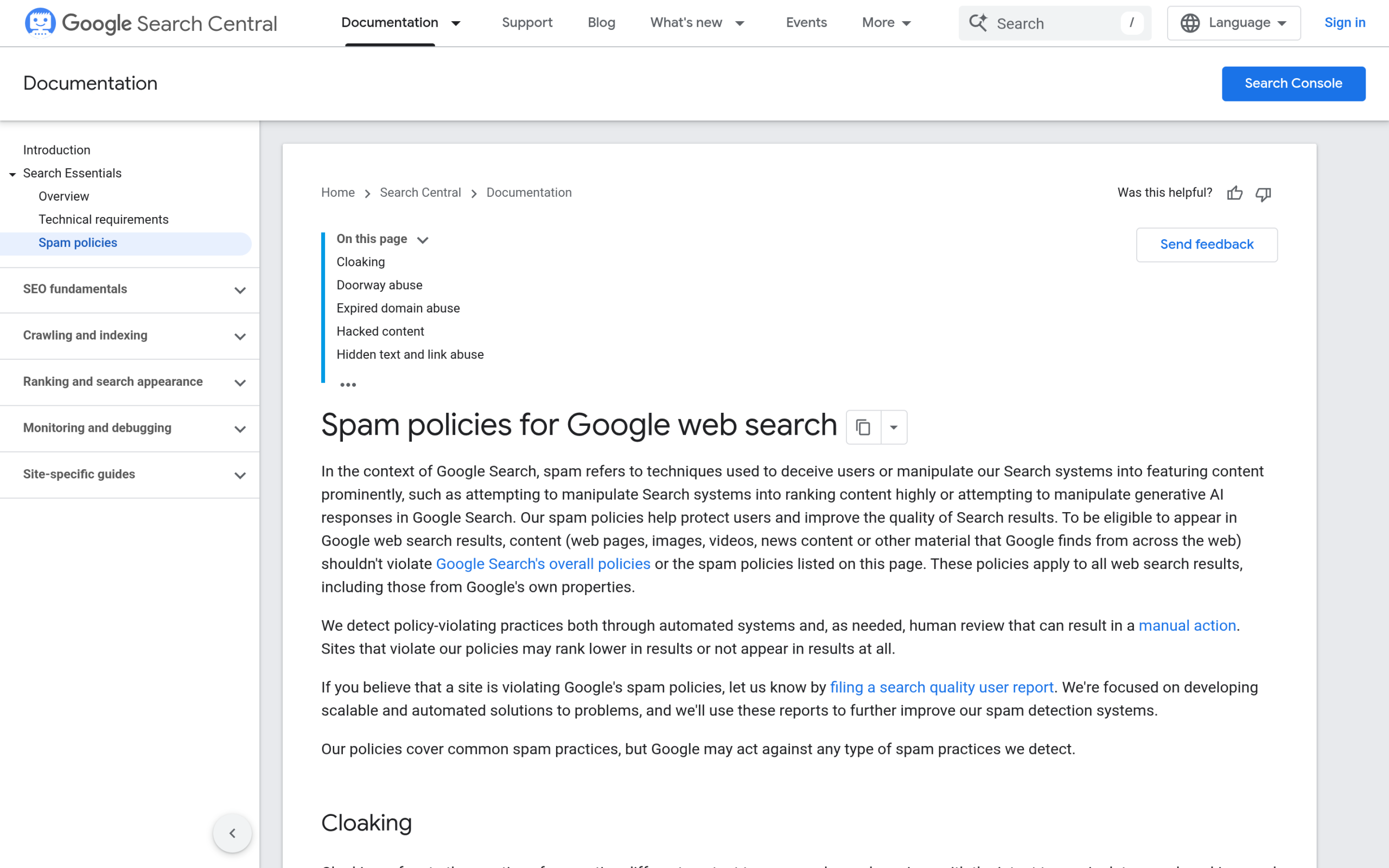
In March 2024 Google added a spam policy called scaled content abuse, and through 2026 it has become one of the most actively enforced policies in search. Here is the definition, word for word from Google’s spam policies page (last updated 2026-05-15):
Scaled content abuse is when many pages are generated for the primary purpose of manipulating search rankings and not helping users.
Read that twice, because the whole thing hinges on “primary purpose.” Google is not banning templated pages, and it is not banning AI. The same page lists the behaviors it treats as abuse, and these are the ones that catch programmatic sites:
- “Using generative AI tools or other similar tools to generate many pages without adding value”
- “Scraping feeds, search results, or other content to generate many pages (including through automated transformations like synonymizing, translating, or other obfuscation techniques)”
- “Stitching or combining content from different web pages without adding value”
- “Creating many pages where the content makes little or no sense to a reader but contains search keywords”
Two neighboring policies tend to catch programmatic sites in the same sweep. Doorway abuse, in Google’s words, is “when sites or pages are created to rank for specific, similar search queries” that “lead users to intermediate pages that are not as useful as the final destination.” A thousand near-identical city pages that all funnel to one contact form is a textbook doorway set. And site reputation abuse targets “third-party content is published on a host site mainly because of that host’s already-established ranking signals,” which is what happens when a trusted domain rents out a subfolder for someone else’s programmatic pages.
The phrase that matters across all three is “without adding value.” A page that swaps one word and repeats the same 400 words adds nothing. A page built on data that only exists on your page adds plenty. Same method, opposite outcome.
The line: useful programmatic SEO vs scaled-content abuse
The difference is not the number of pages. You can publish 10,000 pages safely and get penalized for 50. It is whether each page carries something a searcher could not get from a generic result. Here is the practical split I use before greenlighting any programmatic project.
| Useful programmatic SEO | Scaled-content abuse |
|---|---|
| Each page has unique data (prices, specs, real listings, stats you own) | Each page repeats boilerplate with one variable swapped |
| Every page targets a query people actually search for | Pages target every keyword permutation whether searched or not |
| A human would find the page useful even without a search engine | The page “makes little or no sense to a reader but contains search keywords” |
| Built on a dataset you maintain and can defend | Built by scraping, synonymizing, or auto-translating others’ content |
| Published in reviewed batches, quality checked | Published thousands at a time with no editorial review |
The honest gut check: open one of your generated pages, hide the template around it, and ask whether the core content would be worth reading on its own. If the answer is no, adding 5,000 more copies of it will not help. It will just give Google a bigger pattern to catch.
How to build programmatic pages on WordPress the safe way
WordPress is a good home for programmatic SEO because the pieces you need are already native: custom post types for the data, custom fields for the per-page detail, and a block template to render them. You do not need a separate site generator. Here is the build, in the order I would set it up.
1. Start with a real dataset, not a keyword list
This is the step that decides everything downstream. Before you touch a template, get a dataset where every row has something genuinely different to say. Real prices, real inventory, real measurements, survey results, API data you have rights to. If your “data” is just a list of cities with no city-specific facts attached, stop here. That project is a doorway set waiting to happen.
2. Store the data in a custom post type
Create a custom post type for the entity you are describing (locations, products, comparisons) and attach the data as custom fields, using Advanced Custom Fields or the block editor’s native meta. One row of your dataset becomes one post. This keeps each page as a first-class WordPress object with its own URL, its own fields, and its own place in your sitemap, rather than a query string on a single template.
Also Read: How to Create a Landing Page in WordPress covers the manual version of the layout your template will automate.
3. Build one template with dynamic blocks
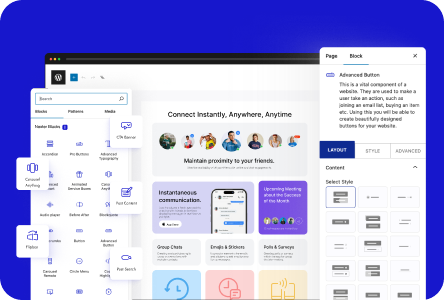
This is where Gutenberg does the heavy lifting. With Nexter Blocks, a free plugin on WordPress.org with 90+ Gutenberg blocks, you build the layout once and bind it to your fields instead of hardcoding text. The blocks that matter for a programmatic template are the Dynamic Content block and Post Meta block (to pull each post’s custom fields into the layout), the Custom Post Listing and Taxonomy Listing blocks (to build related-page and index sections automatically), and Display Conditions (to show or hide sections per post based on the data, so pages missing a field do not render an empty box).
That Display Conditions piece is quietly the most important anti-penalty control you have. It lets each page render only the sections it has real data for, so a location with three listings and a location with thirty do not both get padded to the same identical shape. Variation that follows the data is exactly what a scaled-content filter is looking for the absence of.
4. Publish in reviewed batches
Do not push 5,000 pages live in one night. Publish a batch of 20 to 50, read a random handful as if you were a visitor, and confirm they hold up. Batching gives you a review checkpoint, keeps your crawl budget sane, and means that if something is wrong with the template you find out at page 30, not page 5,000.
Make every page pass the “does this help a user” test
Google’s whole test reduces to value per page. A few habits keep you on the right side of it. Give each page at least one thing that exists nowhere else on your site: a stat, a comparison, a local detail, a chart. Write genuine intros and section copy that reference the specific entity, not a mail-merged sentence with the name dropped in. And build real internal links between related pages instead of a single funnel to one form, so the set reads like a resource rather than a doorway.
Topical depth matters here too. A programmatic set that covers one subject thoroughly, with supporting explainer content around it, reads as authority. A set of orphaned pages with no context reads as a keyword farm.
Structure pages so search and AI engines trust them at scale
Once your pages carry real value, structure is what lets both Google and AI answer engines parse that value across thousands of URLs without guessing. That means consistent, valid schema on every page (LocalBusiness, Product, or ItemList depending on your data), clean heading hierarchy, and semantic markup that mirrors the data rather than decorating it.
Doing this by hand across a large set is where people slip. A free WordPress plugin like RankReady handles the structural half: it generates schema types including Article, FAQPage, HowTo, and ItemList, merges into Rank Math or Yoast’s existing graph instead of duplicating it, and scores each page across 22 AI-readiness signals covering discovery, schema, author credentials, and freshness, re-checking on every publish. For a programmatic set, that per-page scorecard is a fast way to catch the pages that shipped thin before Google does.
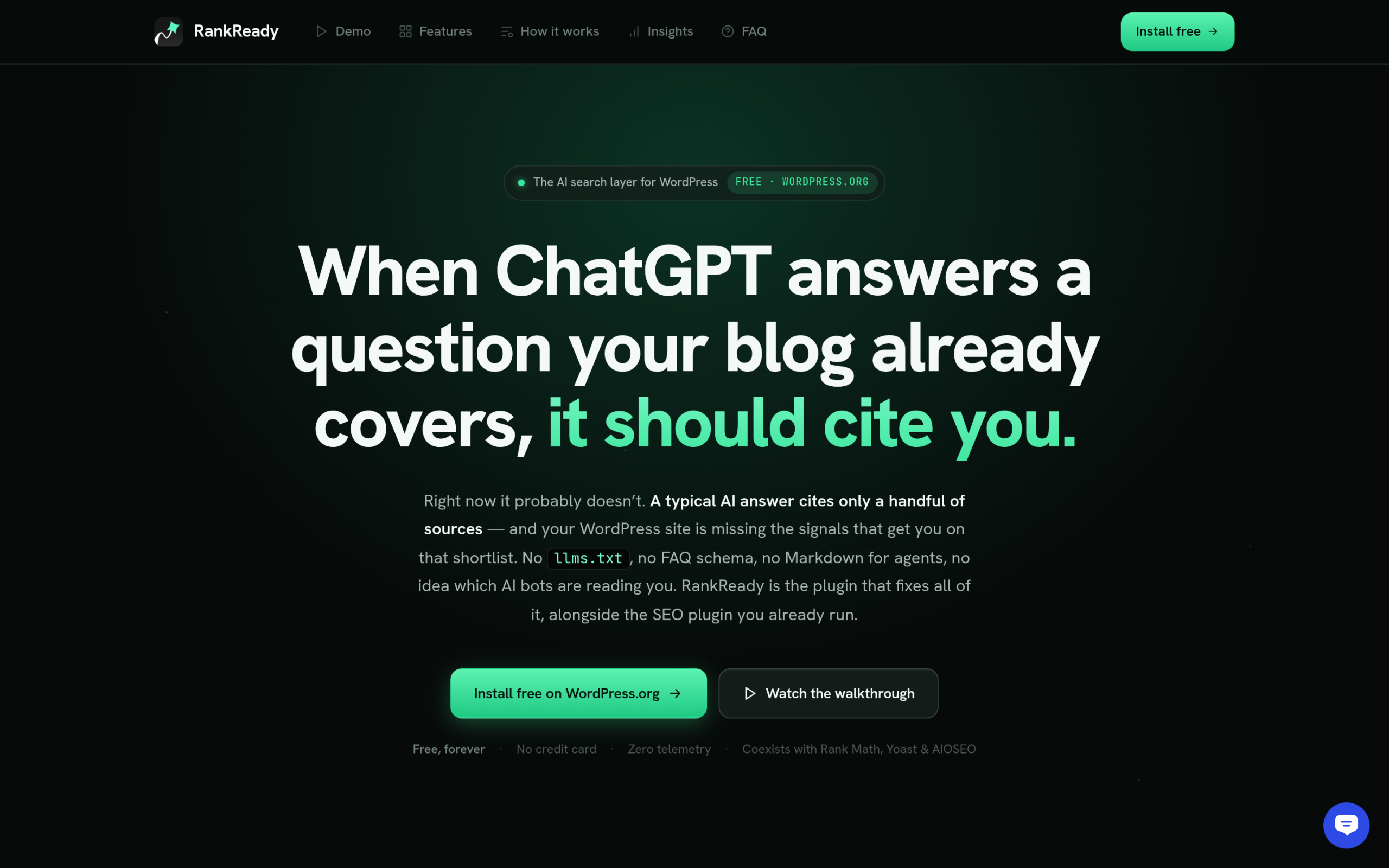
One caution worth keeping on a sticky note, straight from RankReady’s own page: “a thin page with perfect schema is still a thin page.” Structure amplifies value. It does not create it. Schema on a doorway page just helps Google classify the doorway faster. Get the value in first, then structure it.
Your pre-publish penalty-safe checklist
Run every programmatic page, or a fair sample of the batch, through this before it goes live:
- Does this page target a query a real person searches for?
- Does it contain at least one data point or insight that is not on any other page of mine?
- Would a human find it useful with the search engine removed?
- Is the data first-party or properly licensed, not scraped or auto-translated?
- Does the layout vary with the data, or is every page the identical shape?
- Are related pages linked to each other, not just funneled to one form?
- Is the schema valid and does it match what is actually on the page?
A “no” on any of the first three is a stop sign. Fix the page or cut it from the set. One strong page beats fifty thin ones, and fifty thin ones can drag the strong one down with them.
If you already got hit
If a set already lost its rankings, recovery is not a switch you flip. Google’s algorithmic filters lift at core-update intervals, so the work is content-first and the timeline is patient. Start by auditing which pages actually have unique value and which are pure template. Improve or consolidate the thin ones, often many near-duplicate pages should collapse into a few strong ones. Prune the pages that can never be more than a keyword catch. If you got a manual action in Search Console, fix the content first, then file a reconsideration request. If it was algorithmic, there is nothing to file; you improve genuinely and wait for the next update to reassess.
The mindset shift that prevents a repeat: stop asking “how many pages can I generate” and start asking “how many pages can I generate that each deserve to exist.” Programmatic SEO rewards that question now more than it ever has. The sites that survived 2026 are not the ones that stopped scaling. They are the ones that scaled value, not just pages.
Suggested Reading
- What Is a Custom Post Type in WordPress? (A Plain-English Guide)
- How to Create a Landing Page in WordPress (With and Without a Plugin)
- Semantic SEO for WordPress: Optimize for Meaning, Entities and AI Answers
- What Is Answer Engine Optimization (AEO)?
- Best Internal Linking Plugins for WordPress
