










Last year we published a speed benchmark that put Nexter against Kadence on two identical WooCommerce installs. The most common reply was a fair one: of course the theme vendor’s own benchmark makes the theme vendor look good. That criticism stuck, so this round we built the test to be hard to argue with, published the method in full, and included Nexter knowing it would not come first.
Nexter finished fourth of nine. The three themes ahead of it are genuinely lighter and we have left them ahead. What Nexter does win is a different number, and arguably a more useful one, which we get to below.
Why Most Fastest WordPress Theme Lists Are Untestable
Search for the fastest WordPress theme and you get two kinds of page. The first is vendor marketing, where the vendor’s own theme wins. The second is a screenshot of a PageSpeed score from a site you cannot inspect, on hosting you do not know, with plugins you cannot see, on a date nobody recorded.
Neither is a benchmark. A benchmark has to be repeatable by a reader who distrusts you. That is the bar we set here.
How We Measured, and How to Repeat It
Every theme in the WordPress.org directory has a live preview on wp-themes.com. That is the useful part: the same demo content, on the same host, rendered through each theme in turn. The content is held constant and the theme is the only variable, which is exactly the isolation a theme comparison needs and almost never has.
For each theme we fetched the front page, extracted every stylesheet and script it references, downloaded each one, and added up the bytes. We measured uncompressed so that inline CSS and external CSS sit on the same scale. All nine were measured on 4 September 2026 inside the same twenty minutes.
We excluded images deliberately. The demo images differ between previews, so counting them would measure the demo content rather than the theme. Astra’s preview ships thirteen images and GeneratePress ships none, which tells you about the demo, not the code.
- Counted: external CSS, external JavaScript, inline
<style>blocks and inline<script>blocks. - Not counted: images, fonts, the HTML document itself, and anything a plugin would add.
- Where: the public wp-themes.com preview for each theme.
- When: 4 September 2026.
Also Read: Gutenberg Core Web Vitals covers the layer-by-layer speed work that sits on top of whichever theme you land on.
The Results
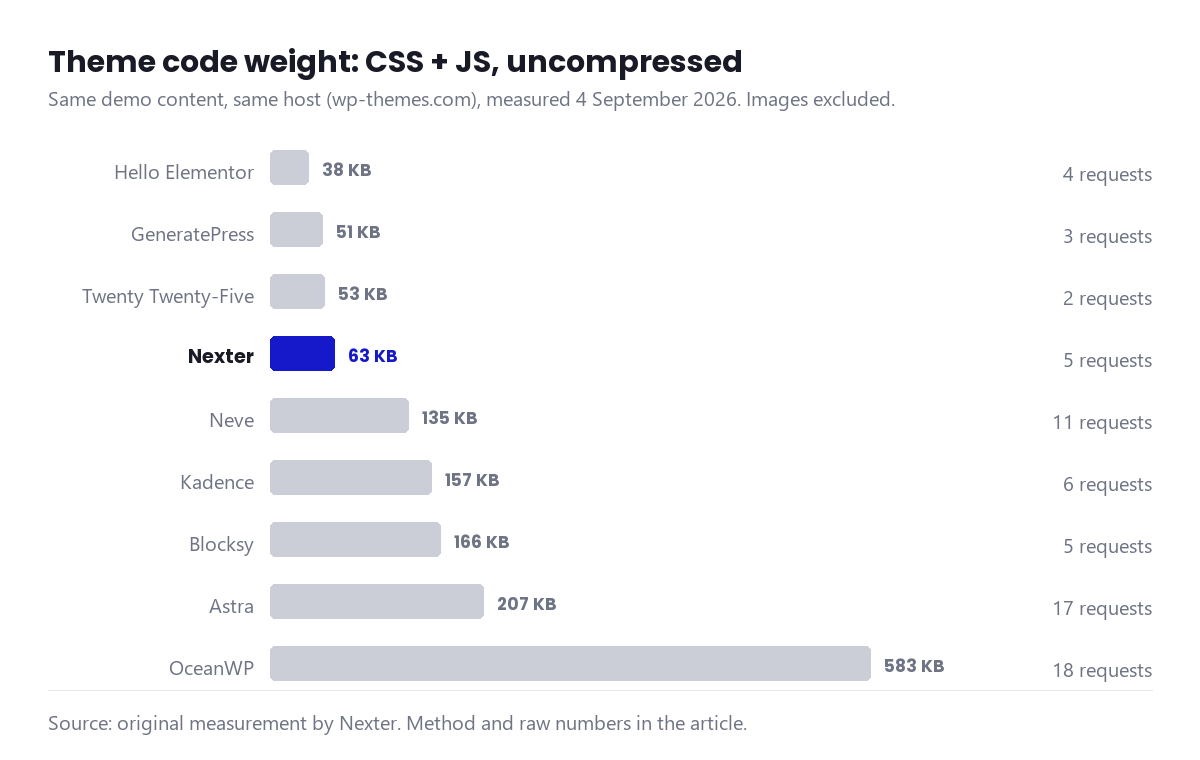
| Rank | Theme | CSS + JS (bytes, uncompressed) | Requests | External JS files |
|---|---|---|---|---|
| 1 | Hello Elementor | 38,726 | 4 | 0 |
| 2 | GeneratePress | 52,678 | 3 | 1 |
| 3 | Twenty Twenty-Five | 53,956 | 2 | 0 |
| 4 | Nexter | 64,575 | 5 | 0 |
| 5 | Neve | 137,946 | 11 | 2 |
| 6 | Kadence | 160,302 | 6 | 1 |
| 7 | Blocksy | 169,879 | 5 | 1 |
| 8 | Astra | 212,471 | 17 | 1 |
| 9 | OceanWP | 597,001 | 18 | 13 |
The spread between the lightest and the heaviest theme in this set is a factor of fifteen.
Nexter Ships Zero External JavaScript
Nexter came fourth on total weight at 64,575 bytes. On the metric we actually build for, it is in the top group: Nexter’s front page loads no external JavaScript file at all. Only Twenty Twenty-Five and Hello Elementor also manage that, and both are doing considerably less on the page.
That distinction matters more than the byte count suggests. CSS blocks rendering but parses quickly. JavaScript competes for the main thread, and main-thread contention is what Interaction to Next Paint measures. GeneratePress, Kadence, Blocksy and Astra each ship one external script, Neve ships two, and OceanWP ships thirteen. A theme that ships none has removed a whole category of interaction delay before you install a single plugin.
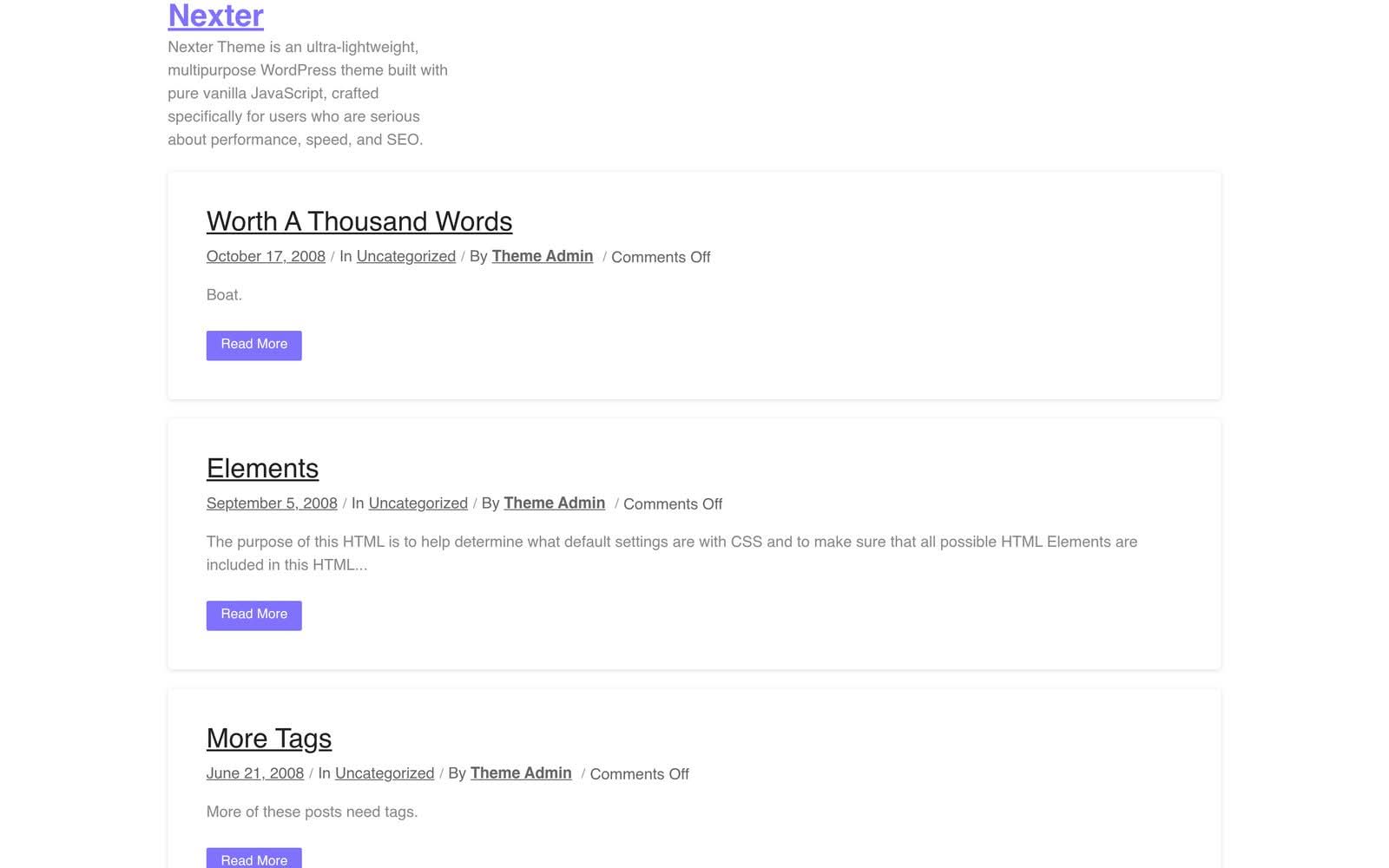
On the WordPress.org directory Nexter sits at version 4.2.18 with a rating of 100 out of 100. That rating comes from 14 reviews, which is a small sample and we are not going to present it as more than that. WordPress.org does not publish an active install count for the theme.
Also Read: NexterWP vs Kadence: Speed Benchmark is the one-versus-one benchmark this article grew out of, run on real WooCommerce installs rather than demo pages.
Why Hello Elementor Winning Is a Trap
Hello Elementor is the lightest theme in the table at 38,726 bytes, and for most people it is the wrong answer. It is a deliberately blank canvas built to stay out of Elementor’s way, the opposite philosophy to a full block theme with a built-in design system. It has no header design, no typography system and no layout options, because the builder is expected to supply all of that.
Install it alone and you get a fast, unstyled site. Install it with a page builder and the builder’s own CSS and JavaScript land on top, at which point the theme’s 38 KB is no longer the number that decides anything. Comparing it to Astra or Blocksy on weight alone compares a chassis to a finished car.
A milder version of the same caveat applies to Twenty Twenty-Five. It is genuinely lean and renders in two requests, but it is a default theme with a narrow design vocabulary.
The Real Finding Is How Much CSS You Never Use
OceanWP is the outlier and it is worth looking at directly. At 597,001 bytes across 18 requests it carries more than nine times Nexter’s code weight and more than fifteen times Hello Elementor’s. Thirteen of those requests are separate JavaScript files.
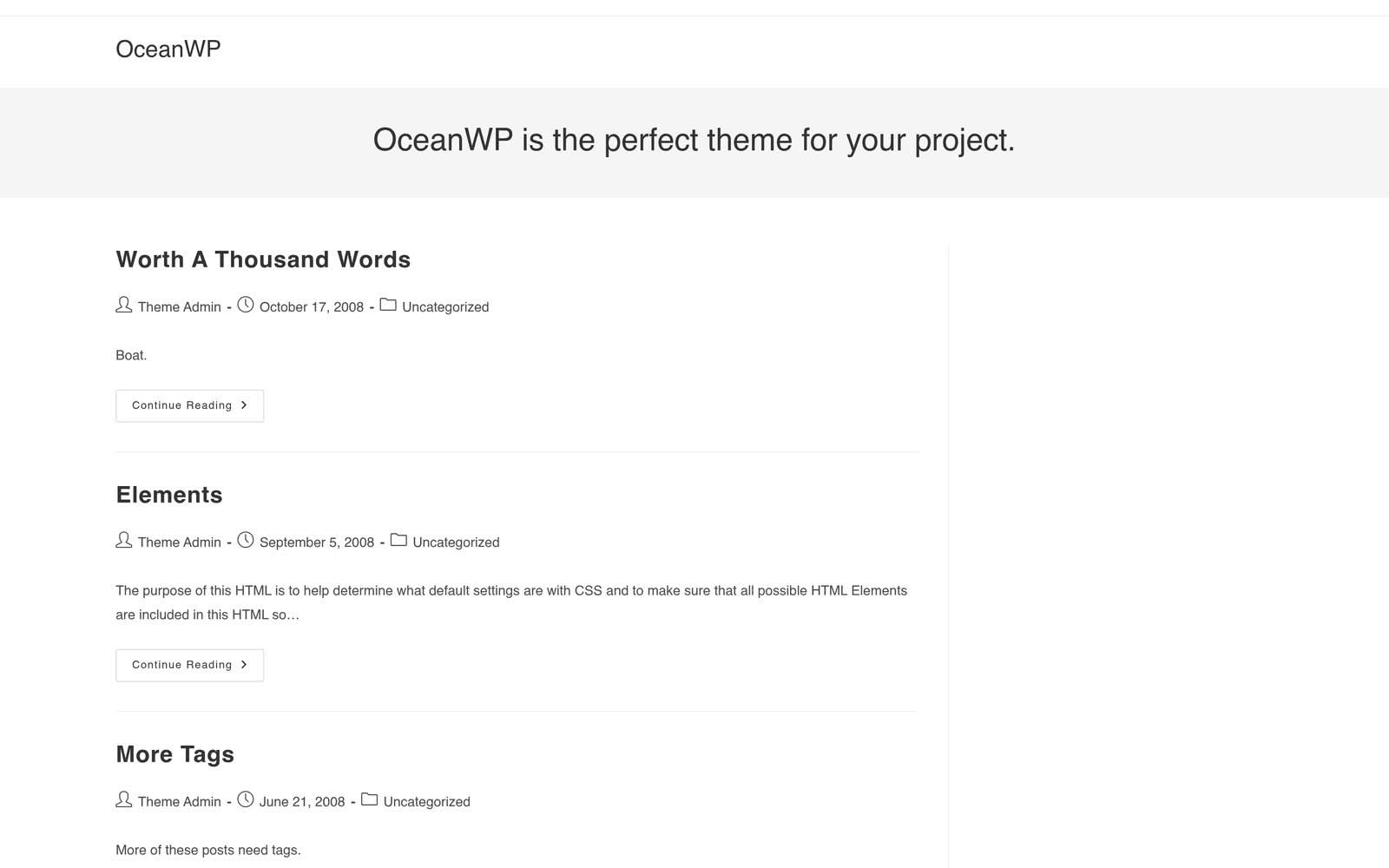
Put that preview next to the GeneratePress one. They render broadly the same demo page. The visible difference is small and the code difference is a factor of eleven. That gap is not design, it is optionality: styles for widgets, layouts and block features this page never uses, shipped anyway because the theme cannot know in advance which ones you will want.
This is the most useful thing in the table. Heavier themes are rarely heavier because they look better. They are heavier because they are prepared for more, and preparation is not free.
What Theme Weight Costs You in Core Web Vitals
Google’s thresholds are specific. A page passes when Largest Contentful Paint is within 2.5 seconds, Interaction to Next Paint is 200 milliseconds or less, and Cumulative Layout Shift is 0.1 or less. Compliance is assessed at the 75th percentile of page loads, segmented across mobile and desktop, so the slowest quarter of your real visitors decides the result.

Half a megabyte of render-blocking CSS will not automatically fail those thresholds on fast hardware over a fast connection. It fails them at the 75th percentile, on a mid-range phone on mobile data, which is the measurement Google actually uses. That is why theme weight is worth caring about even when your own laptop reports that everything is fine.
Where This Test Stops Being Useful
Stating the limits is part of the method, so here they are.
- It measures one page, the preview front page. A theme that is lean on the homepage can be heavier on an archive or a single post.
- It is a lab measurement of bytes, not field data. There is no Chrome User Experience Report data here and no real visitor timings.
- wp-themes.com is one host on one day. Absolute timings would vary between runs. The byte counts would not.
- No plugins are loaded. On a real site a page builder, a form plugin and an analytics script routinely outweigh the theme, and a stale cache or unoptimised images will cost you more than any theme in this table.
- Weight is not speed. It is a strong predictor of speed and it is the part the theme controls, which is why we measured it.
If you want a number for your own site rather than for a demo, run the page through PageSpeed Insights and read the field data section rather than the lab score. Compressing what you serve with an image optimization plugin is usually the faster win.
How to Pick, Beyond the Byte Count
Weight should be one input among several. The WordPress.org directory currently lists 8,562 themes, of which 1,802 are block themes built for the Site Editor, so the field is wide enough that you can afford to be selective, whether you end up on a free or a premium theme.

- Is it maintained? Blocksy was updated on 3 September 2026 and OceanWP on 31 August 2026. GeneratePress was last updated on 1 December 2025, which is a long gap for a theme this widely installed.
- Does the rating have a real sample behind it? Astra’s 98 out of 100 comes from 6,518 ratings. Twenty Twenty-Five’s 78 comes from 13. Those numbers do not carry the same weight.
- Block theme or classic theme? This decides how you will customise the site for the rest of its life.
- Does it load what the page needs, or everything? Conditional asset loading is most of the distance between the top and the bottom of this table.
Also Read: What Makes a WordPress Theme SEO-Friendly? is the companion to this piece: once you have picked on weight, that guide covers the markup and structure side.
The honest summary: GeneratePress and Twenty Twenty-Five are the lightest themes here that still hand you a real design system, Nexter sits just behind them and ships no external JavaScript, and OceanWP is carrying an amount of code that is hard to justify on a page this simple.
Suggested Reading
- NexterWP vs Kadence: Speed Benchmark on Identical WooCommerce Sites
- Gutenberg Core Web Vitals: How to Speed Up a Block-Theme WordPress Site
- What Is a WordPress Block Theme?
- How to Choose a WordPress Theme: 10 Key Factors
- How to Clear Your WordPress Cache: Every Layer Explained
