




MCP gets most of the WordPress-world attention because it’s the protocol that connects an AI model to your site’s tools and data. A2A solves a different problem: getting two separate AI agents, possibly built by two different companies, to talk to each other. If you’re building anything with multiple agents involved, the distinction matters.
What A2A Actually Standardizes
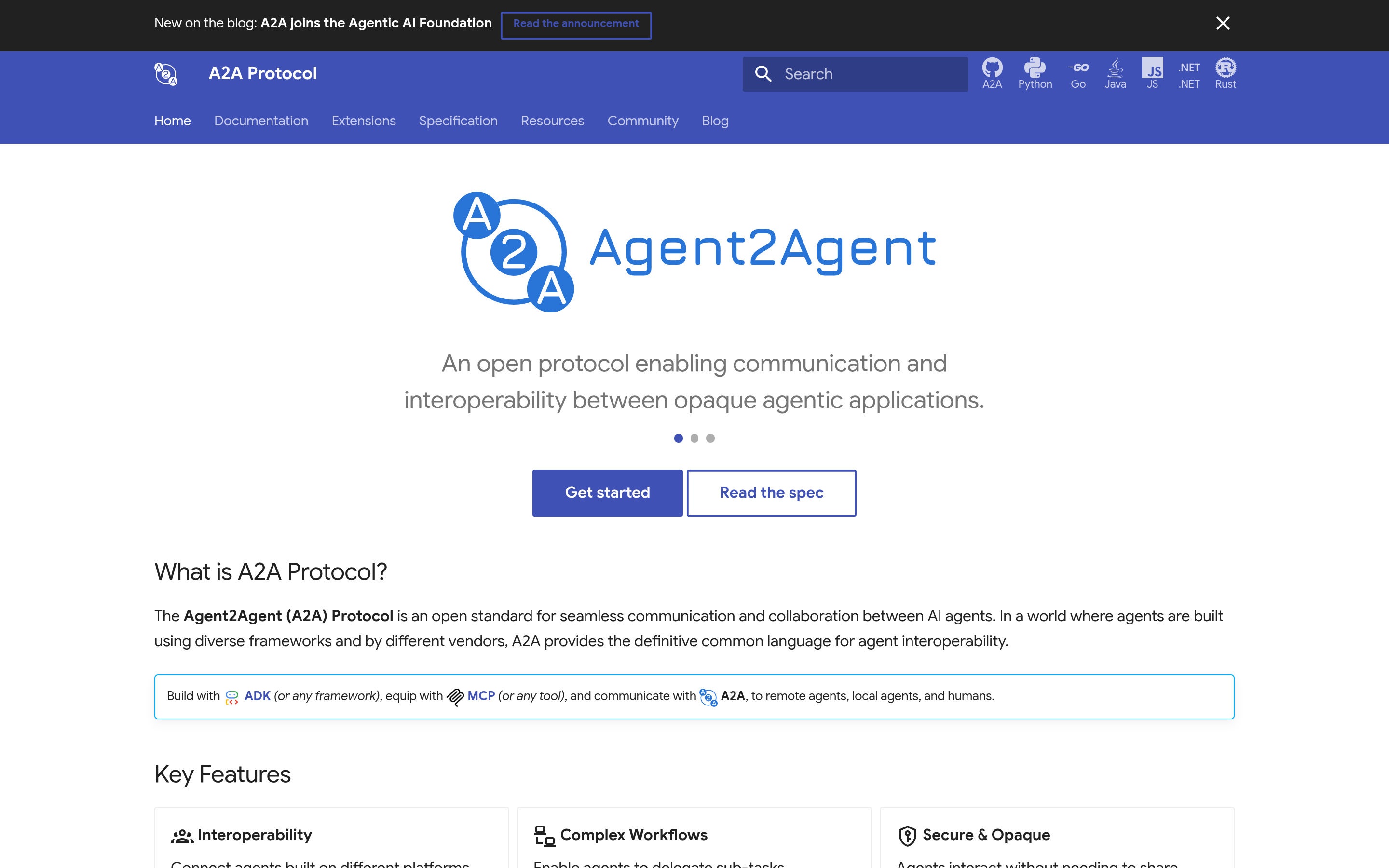
Google introduced the Agent2Agent (A2A) protocol in April 2025 as an open standard for agent-to-agent interoperability: how one AI agent discovers what another agent can do, negotiates a task, and exchanges the results (“artifacts”) back and forth. In June 2025 Google transferred the protocol, its specification, and related SDKs to the Linux Foundation, which established the Agent2Agent project to give it vendor-neutral governance rather than single-company control.
The Basic Mechanics: AgentCards and Tasks
Two concepts do most of the work in A2A. An AgentCard is a published, machine-readable description of what a given agent can do — its capabilities, how to reach it, and what kind of input it expects — the mechanism another agent uses to discover it in the first place, conceptually similar to how an OpenAPI spec describes a REST API’s endpoints before you call them. A task is the actual unit of work handed from one agent to another, with a defined lifecycle (submitted, working, and a completed or failed end state) so the requesting agent can track progress rather than treating the call as an opaque black box. This task-lifecycle model is what lets a long-running job on one agent be checked on or cancelled by the agent that requested it, instead of just waiting silently.
A2A Hit v1.0 in Early 2026, With Real Enterprise Adoption Behind It
The protocol reached its v1.0 specification release in April 2026, and the Linux Foundation marked the project’s one-year milestone with adoption figures that moved it well past “interesting proposal” territory: more than 150 organizations now support the standard, with integration across Google, Microsoft, and AWS cloud platforms and active production deployments across multiple industries. A follow-up release, v1.0.1 in May 2026, added a formal extension mechanism supporting new data types, requirements, RPC methods, and state machines — meaning implementers can extend the protocol for domain-specific needs without forking the core spec. This matters for the “is this real or vaporware” question specifically: a protocol with 150+ backing organizations and production traffic across three major clouds is a materially different claim than an early-2025 proposal.
Where Adoption Concentrates
The industries actually using A2A in production skew toward coordination-heavy, multi-party workflows: supply chain (coordinating autonomous systems across vendors and logistics partners), financial services, insurance, and IT operations. The common thread across all four is the same reason A2A exists in the first place — these are domains where the agents that need to cooperate are built and operated by different organizations on different technology stacks, so a shared, vendor-neutral handoff protocol solves a real integration problem rather than a hypothetical one. A single-company internal automation setup, by contrast, has less need for A2A specifically, since all its agents can often just call each other directly without a standardized interoperability layer.
A2A vs. MCP: Different Layers, Not Competitors in the Way It Sounds
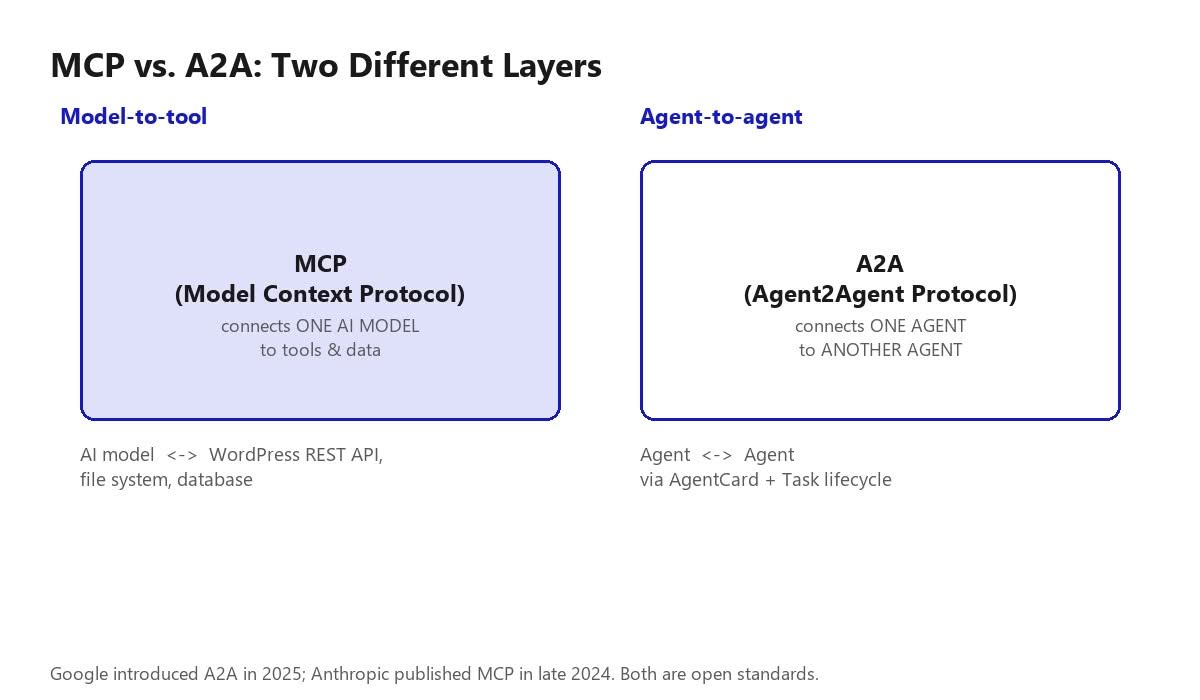
Despite “competing standard” framing you’ll see online, the two protocols solve adjacent, not identical, problems:
- MCP — connects one AI model to tools, data sources, and context (a database, a WordPress site, a file system). Model-to-tool.
- A2A — connects one AI agent to another AI agent, so they can negotiate and hand off tasks between systems that may be built on entirely different stacks. Agent-to-agent.
A realistic multi-agent setup can use both: an orchestrating agent talks to specialist agents over A2A, and each of those specialist agents talks to its own tools and data over MCP.
Also Read: How to Set Up a WordPress MCP Server, Step by Step — the model-to-tool half of that picture, for a WordPress site specifically.
Where This Shows Up for a WordPress Site Owner Today
Direct A2A adoption on individual WordPress sites is still early and mostly relevant to larger, multi-agent automation setups (an agency running several specialist agents across client sites, for example) rather than a single-site plugin feature yet. The practical takeaway is knowing the vocabulary: if a vendor pitches “A2A support,” that’s an agent-orchestration claim, not a your-site-connects-to-AI-tools claim — that second one is what MCP and the WordPress Abilities API cover.
Also Read: AI Agents and Your WordPress Site: What They Can Actually Do in 2026 — the broader, grounded picture of what’s actually live versus still assistive.
A Worked Example: When A2A Would Actually Enter the Picture
Consider an agency running WordPress sites for a dozen clients that wants one central AI system to handle SEO content across all of them. If the agency builds one agent per major function — a research agent, a writing agent, a publishing agent — each specialist agent needs its own MCP connection to the specific WordPress sites and data sources it touches. A2A is the layer that would let the orchestrating agent hand a task (“research this topic, then hand the brief to the writing agent”) to the right specialist and track whether that task is still running, completed, or failed, using a standard task lifecycle rather than a one-off internal API the agency has to design and maintain itself. Below that scale — a single site, or a single agent doing everything itself — there’s no separate agent to hand off to, so A2A has nothing to standardize yet.
A Quick Reference Table
| MCP | A2A | |
|---|---|---|
| Connects | A model to tools/data | One agent to another agent |
| Introduced by | Anthropic, Nov 2024 | Google, April 2025 |
| Current governance | Open specification | Linux Foundation (since June 2025) |
| Core unit | Tool call / resource | Task (with lifecycle) |
| Discovery mechanism | Server capability listing | AgentCard |
| Relevant to a single WordPress site | Yes, directly | Only at multi-agent/agency scale |
Should You Actually Care Yet?
For a single WordPress site, no immediate action is needed — there’s no “add A2A support” setting to look for in your plugins today. Where it becomes relevant is if you’re running (or considering) a setup with multiple distinct AI agents that need to coordinate across systems: a content agent that hands research tasks to a separate research agent, or an agency-level system distributing tasks across many specialist agents for different client sites. If that’s not your setup, MCP and the Abilities API remain the layer worth understanding first.
FAQ
Do I need to choose between A2A and MCP for my WordPress site?
No, they’re not mutually exclusive alternatives for the same job. For most single-site WordPress work today, MCP (or a plugin’s own Abilities implementation) is the relevant layer; A2A matters once multiple separate agents need to coordinate.
Who governs the A2A protocol?
Google introduced it in April 2025, then transferred it to the Linux Foundation in June 2025 as an open, vendor-neutral project, now backed by over 150 organizations rather than kept as a single-vendor standard.
Is A2A a WordPress-specific standard?
No. It’s a general-purpose protocol for agent interoperability, not tied to WordPress or any specific CMS.
What is an AgentCard?
A machine-readable description an A2A agent publishes of its own capabilities and how to reach it — the mechanism another agent uses to discover what it can do, conceptually similar to how an OpenAPI spec describes a REST API before you call it.
Has A2A actually reached a stable release?
Yes. The protocol hit its v1.0 specification in April 2026, followed by v1.0.1 in May 2026, which added a formal extension mechanism for domain-specific customization without forking the core spec.
Conclusion
A2A and MCP aren’t rivals competing for the same job — they’re two layers of the same emerging AI-agent stack, and most WordPress site owners will only need to think seriously about MCP for now. With A2A past v1.0 and backed by 150+ organizations across major clouds, it’s no longer a speculative proposal, but it remains an agency- and multi-agent-scale concern rather than a single-site one. Keep the vocabulary straight and vendor claims about “agent protocols” get a lot easier to evaluate.
Suggested Reading
- AI Agents and Your WordPress Site: What They Can Actually Do in 2026
- How to Set Up a WordPress MCP Server, Step by Step
- MCP Security for WordPress: What You Are Actually Exposing
